
Folge Nr: 237
B2P122 – Holistic Management – Allan Savory
Regenerative Agriculture and beyond
B2P abonnieren
Ganze Folge
Shownotes
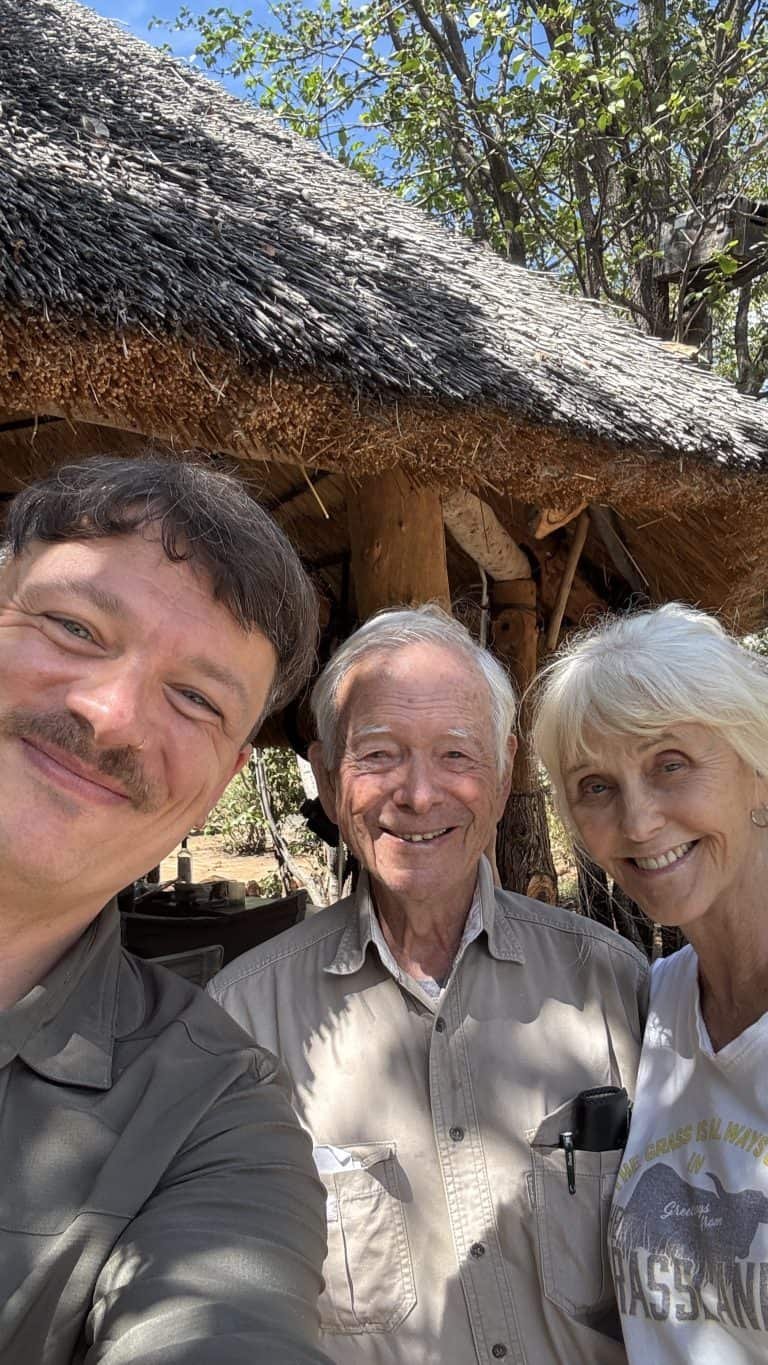
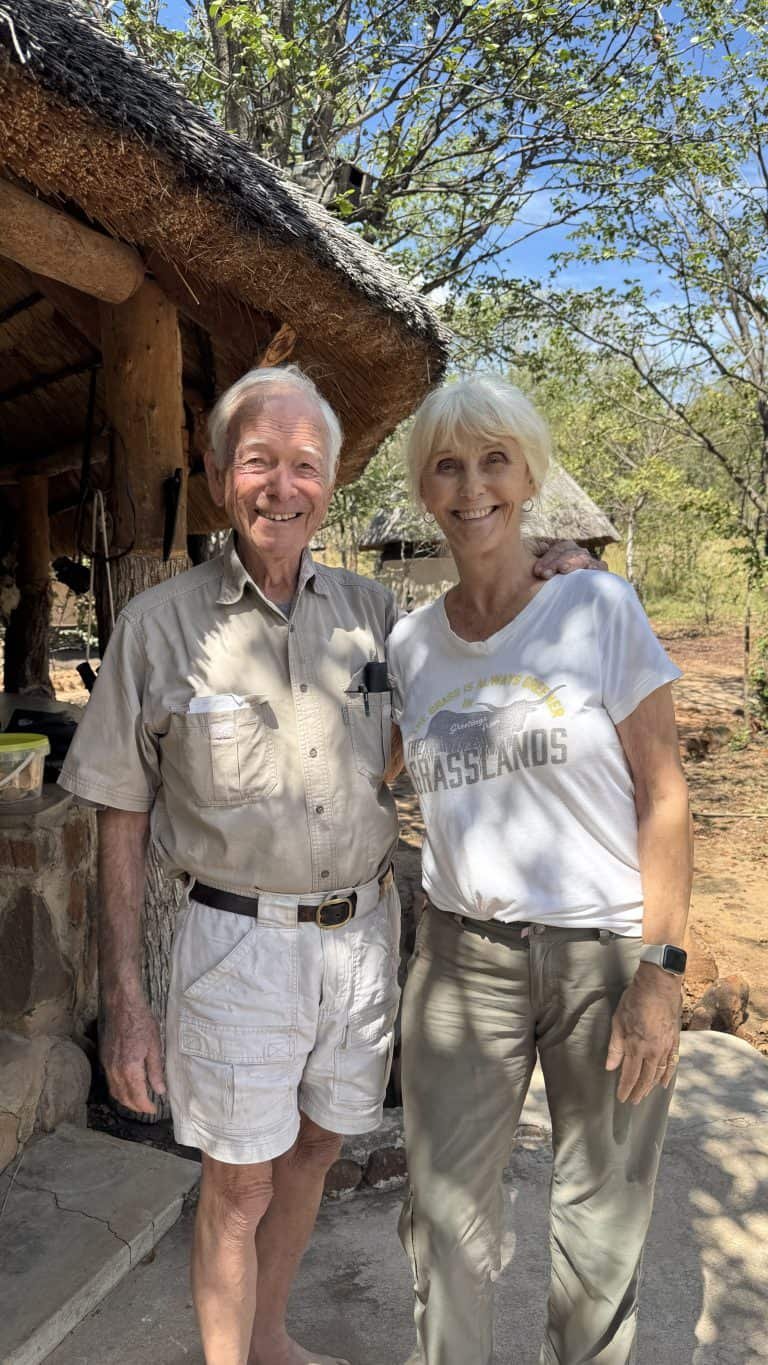
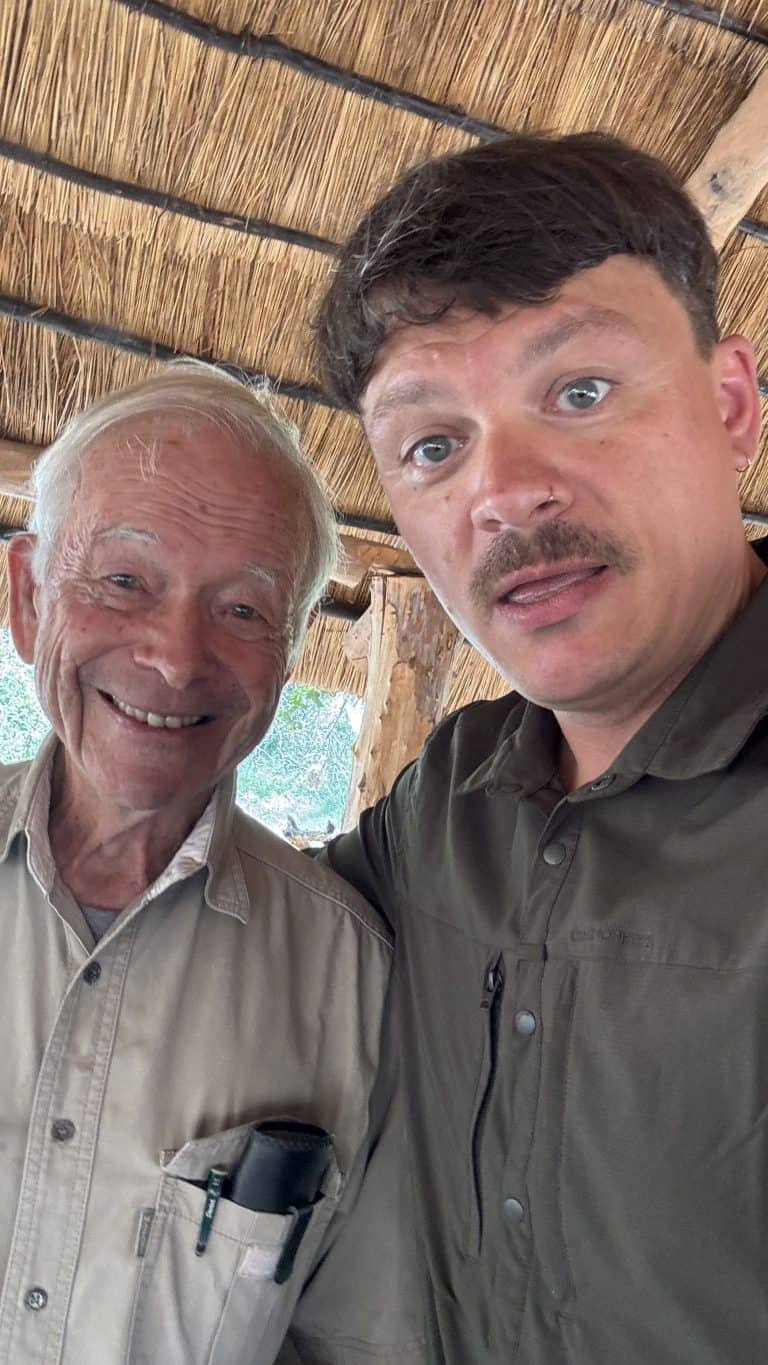
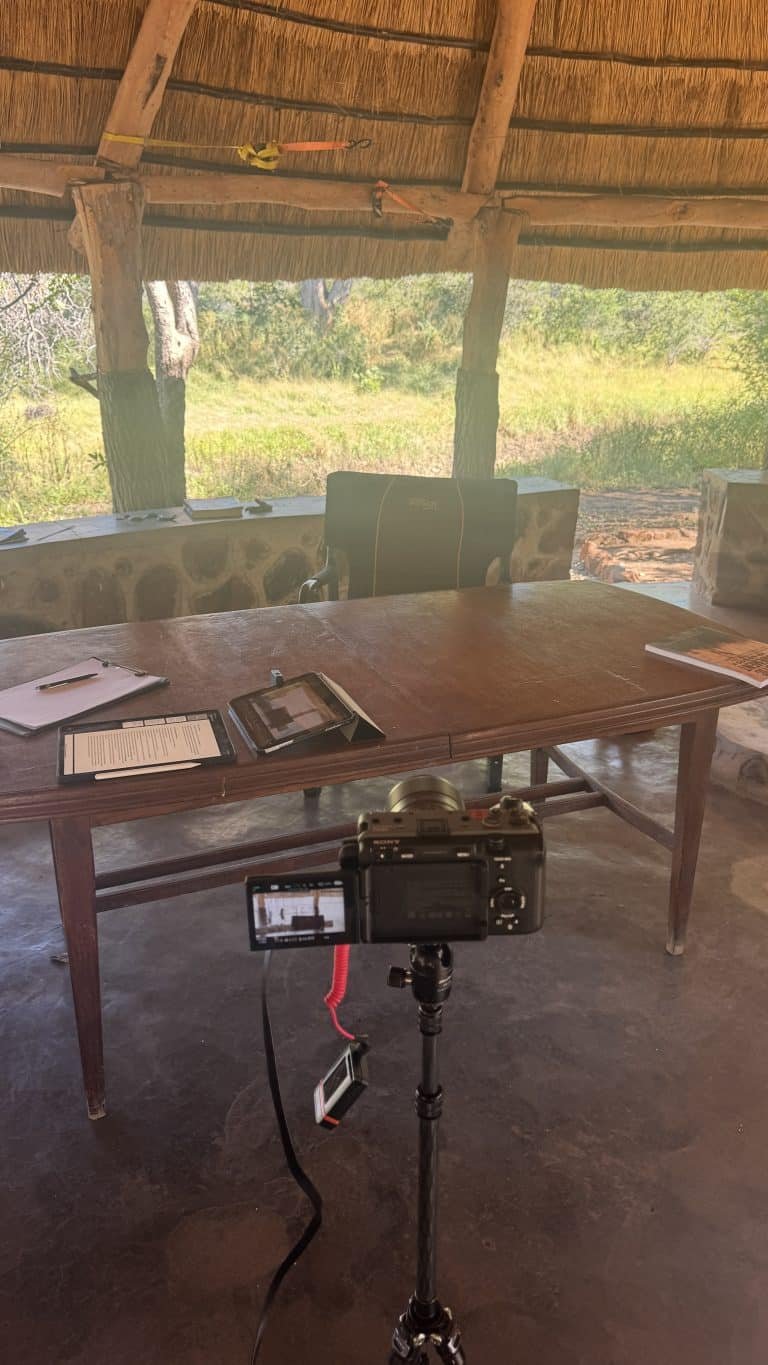
In dieser Ausgabe des BauertothePeople Podcast habe ich Allan Savory in seinem Haus im Dimbangombe Naturpark in Zimbabwe besucht. Allan sprach dabei Englisch, ich habe eine dem englisch ähnlichen Sprache Fragen gestellt. Also “pardon my french” und Danke Allan für dein “Verständnis” in jeglicher Bedeutung des Wortes.
Nicht mal BauertothePeople bringt Allan Savory in einer Folge unter. Der heute 89-Jährige hat nicht nur bereits ein langes Leben gelebt, irgendwie fühlt es sich auch so an, als wären es gleich mehrere Leben gewesen. Er ist ein wenig wie Indiana Jones, nur halt ganz anders.
Wer sich die Geschichte und Geschichten von und über Allan anhören möchte, es gibt viele Videos und Artikel über ihn. Angesichts dessen, dass er für viele der heute prominenten und weithin bekannten Akteure der regenerativen Landwirtschaft selbst der Wegbereiter war, also quasi “the Gurus Guru” ist gerade über ihn, noch verhältnismäßig wenig bekannt.
Einer breiteren Öffentlichkeit wurde er 2013 durch seinen TED-Talk “How to green the world's deserts and reverse climate change” bekannt, wobei er selbst viel lieber auf seine Botschaft für die COP26 aus dem Jahr 2021 verweist.
Allan Savory war nicht nur Landwirt. Sein “Holisitic Management” oder wie er es lieber formuliert “managing holistically” leitet sich wohl aus der jahrzehntelange Beobachtung und Erfahrung als Biologe, Landwirt, Politiker usw. ab, geht aber über die Bedeutung eines angewendeten “Management-Systems” für die Landwirtschaft hinaus. Auf der Makroebene “managen” wir nach Allan uns selbst, unsere Institutionen und die lebensnotwendige Umwelt. Eine wichtige Herausforderung sieht Allan dabei darin, dass wir dabei unser Ego überwinden. Standortspezifisch angewendet und mit Fokus auf die landwirtschaftliche Praxis landet man dann eben bei der Lösung, die Allan 2013 im TED-Talk vorgestellt hat.
In unserem Gespräch versucht mir Allan geduldig aber auch mit fast väterlicher Strenge ein Verständnis des dahinter liegenden “Holistic Management” zu vermitteln. Es geht hier auch um ein Lebenswerk.
Ich bin gespannt, was ihr davon mitnehmt. Viel Freude beim Reinhören und Reinschauen und ja, nochmal, pardon my french!
Frag deine Folge:
Einblicke
Links zur Folge
https://savory.global
Allan auf Wikipedia
https://en.wikipedia.org/wiki/Allan_Savory
Transkriptca. 24.900 Wörter
0:00 Allan: The biggest problem facing humanity is not atomic warfare, threats, arms race, space travel, it's none of those things. It's the destruction of human habitat. You can live without food and water longer than you can without habitat. The country ran on the black market. It was more honest, more integrity, and the whole country ran on barter and trade and honest dealing between people. There's far more dishonesty in the banking, the legal, the conventional system than there is in the black market. In the black market, if you're dishonest, you're out. Nobody trades with you.
0:46 So we suddenly found things much more honest, and the country kept going. And as you travel around here, you will see thousands of trees that have planted themselves without a dollar. While the Chinese and other countries, UAE, are spending billions, probably trillions of dollars planting trees. And never asking, why do you need to plant them? If your management's right, they'll plant themselves. They did for millions of years. They didn't need us to plant them. The fact that you're having to plant them indicates something's wrong.
1:20 I don't even defend the holistic framework if you or anybody came up with a better way simpler way of managing complexity tomorrow I drop everything I've spent my life on and adopted because I have no other desire than to be a good scientist and leave a better world.
1:43 Music: Music
1:50 Willy: Bauer to the People, der Podcast für Perspektiven rund um Essen, Menschen und Landwirtschaft. Weil nur durchs Reden kommen die Leute zusammen. Hello everyone and grüß euch. Yeah, in this episode of the Bauer to the People podcast, I visited Alan Savory at his home at the Dimbangombe Nature Reserve in Zimbabwe at the African Center for Holistic Management. Alan spoke English, and I fired off my questions in a sort of Englishish. But I guess ever since Arnold bulldozed his accent into the US, people have somehow been learning to cope with it.
2:34 So pardon my French and thank you, Alan, for your understanding in every sense of the word. Not even we here at Bauer to the People could cover the full scope of Alan Savory in just one episode. Now 89 years old, he's not only lived a long life, it actually feels like multiple lives wrapped into one. He's a bit like Indiana Jones, but of course completely different. If you want to dive into Alan's story and the many stories about him, there are plenty of videos and articles available. Considering that he paved the way for many of today's prominent figures in regenerative
3:15 agriculture, essentially the guru of the gurus, it's surprising how relatively little is still known about him and his work. He became widely known to the general public in 2013 with his TED talk How to Green the World's Deserts and Reverse Climate Change. Though he himself much prefers to point listeners to his message from COP26 in 2021. Why is that? Alan Savory wasn't just a farmer. His holistic management, or how he more accurately calls it, managing holistically, stems from decades of observations and experience as
4:02 a biologist, farmer, politician, and more. But it goes well beyond a mere management system for agriculture. On the macro level, according to Alan, we are managing ourselves, our institutions and the essential environment. A key challenge, he says, is overcoming our own egos. When this approach is applied to a particular location, of course, and centered on agricultural practices, it then leads directly to the solution Alan presented in the 2013 TED Talk. But it goes well beyond that. In our conversation, Alan patiently and with almost fatherly firmness guided
4:45 me towards an understanding of the principles behind holistic management. This is a life's work we're talking about. I'm curious what you will take away from this episode and how you will understand managing holistically. Anyhow, enjoy listening and on our YouTube channel watching. And yes, once again, pardon my upcoming French. Ellen are you ready yeah yeah okay let's start um i will start with a short introduction um yeah and after that you tell me if i was true about it or if i made the first mistake already before i've been starting the interview um well uh welcome
5:33 to the audience uh to the new Bauer to the people episode uh i'm here in the african center for holistic uh management at Dimbangombe Yes. Is it right? Yes, first, first. Conservancy in Zimbabwe. Today I'm talking with Alan Savory, and you're an ecologist, and you're so much more, but you're a global pioneer on holistic management. And in general, holistic management in general, and the application of holistic management on agriculture or pasture management.
6:09 Allan: Well, any walk of life. It's not just about agriculture, but agriculture features greatly for reasons I'm sure we'll explain.
6:18 Willy: Yeah, of course. So it's a general concept, holistic management, but you're broadly known, at least to farmers in Austria, where I heard first of you, in terms of agriculture or pastoral management, right? Um yeah uh and with an slight age of 89 uh years of age yeah uh you are so much more than uh just an ecologist or the pioneer uh you lived a life that people like myself can't even imagine how to live a life like that there was so much you did but today we want to focus on your concept of holistic management
7:01 uh and try to understand what it is all about and how to apply to agriculture or to life itself yeah so that should be the focus for today i
7:11 Allan: Can tell you right now you can't apply it.
7:13 Willy: Yeah okay let's go done you
7:17 Allan: Don't apply management okay it's management and you if somebody says applying management it's like sending your daughter for music lessons and she comes back and says, I've learned to apply the violin, you would say, there's something wrong there. So it is just holistic management or managing holistically, and you can only practice that. You can't apply it.
7:44 Willy: Yeah, like tools.
7:46 Allan: Yeah, and people have completely misconstrued it, and there are so many derivations of my work because of academic and human egos, and those you can apply, but they will fail. Because they've converted my work to some sort of management system.
8:06 Willy: And you're not a fan of the term management system by Alan Savory.
8:13 Allan: Oh, absolutely. You must use a management system where everything is predictable. So in any business, army, anything, you need a management system for inventory control, accounting, anything of that nature where everything is accountable or reasonably predictable. But you would never dream of a management system for your life, a management system for a business, an army running on the management system. You'd lose a war. So why the hell are people talking about management systems for agriculture?
8:51 That's doomed to failure. And all these adaptive management grazings, mob grazing adaptations of my work, they're all doomed to failure. Because people are not getting the idea, it's just about managing realistically.
9:08 Willy: And to get the idea, first glimpse of your idea, I'm here today. But before we start on the term holistic and the term management, as you understand it, Let's just briefly, a very brief history of Alan Savory. We are here in Zimbabwe. Did we end up here today so how do you you were born in Zimbabwe but you traveled all over the world and you had to live all over the world but you came back to Zimbabwe and to do what now so what brought you here well
9:45 Allan: What brings me here is this land I donated this for the good of the nation and the world as a place where people could see management holistically in practice like this, as you can here. The results here are phenomenal. I mean, they've even amazed me. I was just thinking today, we've probably increased the production of the land here more than tenfold, probably twentyfold in the last 30 years. It's just mind-blowing. And as you travel around here, you will see thousands of trees that have planted
10:24 themselves without a dollar, while the Chinese and other countries, UAE, are spending billions, probably trillions of dollars planting trees and never asking, why do you need to plant them? If your management's right, they'll plant themselves. They did for millions of years. They didn't need us to plant them. The fact that you're having to plant them indicates something's wrong. So anyway, that's what brings me back here all the time. And yes, you're right, my life's been very varied, and that's why I'm just completing now a memoir of the years,
11:02 and the circumstances that led to us being able to discuss as we are today. The managing holistically, which we'll come to, could never have been developed by me or any one person. It could never have been developed by any university, environmental organization, government, never. Could never have been developed in any one country. It could never have been developed at any time in history. It developed from a unique set of circumstances in this country. Dying empire, dying colonialism, violence, war, change, and very small population governing the country.
11:51 And from that it arose, but it still couldn't have if I hadn't been forced into exile. And because of my military role, scientific role, political role. Many roles. Yes, many roles, all at the same time because of small population, and then I was forced into exile. And then far-sighted bureaucrats in the USDA, the U.S. Department of Agriculture Soil Conservation Service, they'd been watching my work. And when I went there as an exile, they commissioned me to put 2,000 scientists through training over two years in the management framework I was known to be developing.
12:34 Willy: They were already watching you before you
12:36 Allan: Went to exile. Yes, at least in Texas, universities there had plagiarized my work in 1978. As I learned, when I got to America, I was told, oh, this was developed in Texas. And I was presented with my own work.
12:55 Willy: How was that?
12:57 Allan: Well, I just changed the name because they'd got the ball by the udder. They'd got it wrong.
13:05 Willy: They got it wrong then?
13:06 Allan: Oh, yeah. Like all the derivatives, they'd got it wrong. They'd converted my work to a grazing system, which it wasn't. So anyway, that's the history. So yes, it could only have been developed in those circumstances, and I've written a memoir about that. Because that'll help people understand.
13:27 Willy: The context of it all. But if a system like yours, like a general approach...
13:33 Allan: Well, it's not a system, so get that straight.
13:35 Willy: Get it straight. How would you, holistic, you call it holistic management.
13:40 Allan: Just managing holistically.
13:42 Willy: Managing holistically.
13:44 Allan: Or holistic management. Can I say approach?
13:47 Willy: Can I say your approach?
13:49 Allan: Well, would you, I mean you are managing your life, would I say your approach? You see how awkward it is for us. Because it's just a new paradigm and adults find it hard to learn something new like this. We get very uncomfortable if we talk about going up south for holiday why is south down, It isn't. But we've come to think of it that way. We don't go, say, we're going right-east on holiday, or left-west on holiday, or anything like that. But we say up and down for south and north. You see, the human mind just gets into a rut like that.
14:35 We've known for centuries that the world is not flat and that the sun doesn't go around us. But everybody listening to us today, I bet they talk about the sun rising and setting and the moon rising and setting, because we didn't change our language. And we've known for centuries that the sun doesn't rise, the sun doesn't set, we spin into the dawn, we spin into the evening, but the moon does rise and set. You see, so again, we're having that difficulty with language because this is a new paradigm.
15:11 Managing our lives holistically instead of what we've done for a million years, which is, like all tools and animals, to manage in a reductionist manner.
15:24 Willy: So how can managing life holistically, which is very broad, would apply for everyone, everywhere, all the time, right? Can develop under such very, very specific circumstances that you had here in Zimbabwe when you grew up. How could that general evolve out of something that specific?
15:48 Allan: Yeah. Let me put it this way. Humans, we're a tool-using animal, and we've had a framework that we weren't aware of because we used it for a million years. So like fish in a bowl, they don't see the water. And in 1983, when I was in exile and working with 2,000 scientists who were brilliant, bright people, etc., that's when we broke through and realized, oh my God, we've always had a simple framework for every bit of management from the household to government policy and beyond. But we didn't recognize it. Now we recognized it and we've made some modifications to it.
16:30 Handle the fact that we've already destroyed more than 20 civilizations, and we're now heading for global destruction of civilization. And it's because there are two glitches. So think of the management framework that humans have always used as though it was software. We have a brilliant mind, but it uses software. And there were two glitches in the software. We discovered those in 1983. Now, one of those I discovered in this country. The second of those we discovered. Two thousands aren't just working with me. That's why I say we and I.
17:13 Now, only the first of them we discovered here, and that was, goes against all human belief. Humans believed that livestock, cattle, sheep, goats, camels, caused desertification. And the 20-odd civilizations, the biblical civilizations that had gone under desert sands were blamed on the shepherds with too much livestock. That became a scientific truth, even though there was no science behind it, in every university in the world. And what I discovered in the 1960s was that's false and that we cannot reverse
17:59 global biodiversity loss, desertification, megafires, fueling climate change, now feeding on each other. We cannot reverse that with fire and technology, Any technology, even imaginable in science fiction, cannot because it's an oxidation problem. It's a problem of biological decay turning to chemical breakdown or oxidation, which we can see right here. You've got me under a thatch roof, and it's yellow on the inside. If you look on the outside, it's dark black. Why? On the outside, it's in sunlight, and it's oxidizing. This is only dry grass.
18:44 And this was happening in this country, and when I recognized what was happening, I realized only animals with a moisture in their gut can deal with that. No technology can. Over millions of hectares of the world every year. There's no way you can deal with that with some technology, and fire can't do it. And humans only had two tools, fire and technology. We've never had any other tool except the idea of resting the environment to let biodiversity recover. Now, that's a wonderful idea if you're in London or Paris or humid areas of
19:30 the world or in a wetland or an ocean, marine environment, anywhere where moisture is pretty consistent through the world. If you rest the environment, no matter how badly you've damaged it, biodiversity will begin to recover. Now, what we discovered here and then confirmed in America, where they had dozens of research plots put in, when you're in seasonal erratic environments, as this is, whether the rain is high or low, So if you rest the land. Grass and brush and trees, as you will see here, if you come a few months from
20:11 now, everything out there will be dry. And if it's in the air, in sunlight, it'll be oxidizing and not biologically decaying if you don't have enough animals.
20:24 Willy: It will become the roof.
20:26 Allan: It'll become like the outside of the roof.
20:28 Willy: Leaving no water into the soil.
20:29 Allan: Well, it starts to kill the vegetation when you start to get bare ground, etc.
20:35 Willy: And therefore you need livestock to manage?
20:37 Allan: Well, you have to, in the areas where the humidity was pretty permanent, like much of Austria, right, where it's fairly permanent, then if you damage the environment, it will recover, as I said, because biological decay continues and nature fills the vacuum. Now, in these environments, there used to be millions and millions and millions of animals in numbers that humans can't even imagine today. And the moisture was in their gut. That's where the moisture was. When the soil and the atmosphere went dry,
21:20 these large animals in their moist gut digested and broke down most of the vegetation. So that we discovered here. So there are two glitches I said in the software. One is we didn't have the tools in the tool bag to be able to stop what happened to all those biblical civilizations. When they killed off the wild animals and domesticated a few, and they were doomed from then on. The only thing that could have saved them was the livestock if they'd known how to manage them. So we discovered that here.
21:57 Now, we thought we'd got success. We were getting some amazing results. But when I was forced into exile, just that time, some were beginning to go wrong. There was something we were missing. We didn't know what it was. When I was given this opportunity and commissioned to train 2,000 scientists, with them challenging everything, and I had an hour every day, which I devoted to nothing, but we cannot afford to be wrong. We have to find if we're wrong. So we'd spend one hour every day doing nothing
22:35 but criticize our own work, the logic and the science, until we could not find flaws any longer. At that point was when we broke through and had discovered the second glitch. The weak glitch. Yeah, the glitch in the software. And that is simply that every human has always believed that we manage in different ways. We've got lots of ways of managing, lots of ways that governments develop policy. You can manage scientifically, dictatorially, democratically, et cetera, et cetera. And what we discovered is, oh, my God, no.
23:15 All tool-using animals, baboon, otter, vulture, human, manage exactly the same way. It's genetically embedded in us. There's a simple framework, and that's how we manage. And there's a problem with it. There was no problem with it until we got use of fire. So the way humans managed for a million years, we could not adversely affect our environment any more than any other tool using animal. And so we had technology, which was primitive stones, sticks. We could sharpen the sticks. We could chip the stones. stones,
23:57 we couldn't change our environment. When we acquired fire, we could melt the stones, go into the bronze, the copper, copper, the bronze, the iron age, and every bit of technology that you're photographing me, the clothes we have made possible by fire. Now, once we had that, that decision-making management framework became damaging, and we didn't know why or how. So we discovered that, and the fact that we only manage in one way, at all levels, and we could change that slightly. So let me show you how that works.
24:38 You correct me if I'm wrong, please. I don't know you, I'm only meeting you now. But tell me if I'm wrong. If I predicted to you, haven't you made every conscious decision in your life? Conscious decision. Not if your hand touches a hot stove. You don't make a decision, you just pull it away. I'm talking about a conscious decision. Haven't you made, and every listener, made every conscious decision in your life to meet a need you had, a desire you had, or to solve a problem you had?
25:15 Willy: The answer would be yes, but there are more conscious and less conscious decisions.
25:19 Allan: It doesn't matter, they are still conscious decisions and they are always to meet a need, a desire or solve a problem. It's very difficult for any human to think of a conscious decision that doesn't fit one of those three. There's the problem. The world is holistic and complex, and that we will never change that way of making decisions. Never. That's a mistake I made. I thought we could change decision-making. No, we will never change it. What we have to do is change management. So when you and I, and all humans have that as the reason for our decisions,
26:04 that is correct, and it will always be. It is for me, it is for this place, but now, instead of that being both the reason and the context for the decision, we now develop a holistic context where humans decide how they want their lives to be tied to our life-supporting environment and our behavior and that becomes the context while we meet our needs desires and you get this totally different result we're getting here no matter how badly you do it we have not managed perfectly we've made many mistakes but this place just gets better and better and better you.
26:49 Willy: Said it when you went to to texas you saw that the scientific way or the way we did agriculture or we did management systems was actually wrong. But it was a narrative. It was a narrative that we are living in, that we are working alongside. What you're proposing now is a change of the narrative that we were in common over many, many years or many, many centuries, perhaps, how can you change a narrative that is so strong and holds us together into a new, like a paradigm shift, as you said.
27:28 Allan: Well, this, I wouldn't have expressed it as a narrative. To me, that's a story. What, The problem we have is that we're adults. And I'm deadly serious there. I've trained thousands of people, from illiterate people to professors at prestigious universities. I have never, ever found ignorance block learning. Never. The only two things I've found block learning are what we already know, as adults, and our egos. And our egos, and particularly professional egos, are the biggest vested interest in the world, bigger even than financial vested interests.
28:23 Whole nations have gone to war over one man's ego. And our egos in our universities, our institutions, our professional people block learning, and what we know blocks learning. So the ideal, and I don't have the answer to this, but the ideal would be to work with young people. I'm not being facetious or anything, but some of the most intelligent people I've met have been illiterate. Some of the least intelligent, you can complete the sentence. I don't want to say the wrong thing.
29:00 Willy: Yeah yeah yeah so so how to put it uh how can one overcome you said your hope is for the future or for the youth for the young people um but there are still people in institutions there are still people managing this world like i am like others are uh we can't wait for the for the youth to to to grow up and to apply a new, how do you say, managing holistically. How can we change a running system in order to do the right things?
29:39 Allan: How would you do that? I tried to explain this at COP26. Let me try again.
29:49 Willy: I will link the video in the show notes.
29:51 Allan: Yeah. Now, let's first just back off a little bit. The whole world now is not in denial. Every sane scientist is now acknowledging that humans are causing climate change. So global biodiversity loss, desertification, fueling climate change, feeding on each other, humans are causing it. Now, science is logical. If humans are causing it, then it is impossible for fossil fuels to be causing it or livestock. And yet every global conference on climate or biodiversity, these are the things most blamed.
30:39 You cannot blame your resources. You can have many things influence a problem, but only one root cause. So if humans are causing climate change, then it means management is. It's how we manage fossil fuels, how we manage livestock, how we manage our resources. That is what's causing climate change. So now that to me is very plain. Why has nobody in the media, no Nobel Prize laureate, No National Academy, U.S. National Academy of Sciences, Royal Society. Why haven't they acknowledged that? We're still going on with conferences where everybody is blaming the resources.
31:28 So we seem to lack common sense today at a higher level. Now, when we look at management, as I tried to explain in that very short talk, all right if if you say to world leaders you need to address management now that's, daunting that's overwhelming if i was a political leader again i would say i don't know what the hell to do yeah that's too big so let's break that down what do we manage and what do we produce so i did that in that 12 minute talk and we produce millions of things we produce beef wine, cheese, smartphones,
32:10 bombs, computers, music, art, literature, buildings, trains, you name it. We produce millions of things, including our food. That's not where the problem lies, because that's not management. You don't manage food. You don't manage cell phones. You produce them. You don't manage bombs. You produce them. And everything we produce is complicated. It's not complex. Nothing we produce is complex and self-renewing, etc. All right, so that's not where the problem lies, but that's where 100% of the discussion, argument, and conflict lies.
32:51 But it's not where the problem is. So then what do we manage? And really, we only manage three things. We manage ourselves, our families, our communities, and at scale we manage organizations, institutions. Most humans can't even make a toothbrush today because it's made by a corporation. All right? So we manage at the human scale or the institutional scale. Now, the first thing the family has to do, or the institution has to do, is to manage the economy, because if it can't finance itself, it fails.
33:30 If a farmer can't finance the farm, they end up committing suicide because they can't sustain their family. If a political party can't finance itself, it's out. It's the same for all of us at that level. So we manage humans and our institutions, we manage our economy, and through them we manage our life-supporting environment or nature to produce music, art, literature, wine, beef, food, cell phones, bombs, everything. So we've only got to focus on three things. Now, I wish some scientists in the world would tell me where I'm wrong.
34:12 I cannot get a single scientist in the world to say, Alan, you're wrong, and this is why. Because the whole of human survival hangs on this. I believe that. Now, when we. Look at that problem, all right, and then let's look at something else. When we manage at scale, government policies etc they're all formed by experts uh you've got the political persuasion of the party and then you've got the institutions and their experts universities farming organizations whatever they nominate their experts to come together and let's say form policy now experts in what?
35:00 They're experts in production. I don't know, you know, they talk of peer review. I don't know who my peers are. Because for 70 years, I've been working on trying to understand managing complexity, and I don't know who to talk to. But I'm constantly told my work's not peer-reviewed. Well, who the hell are they? Because the experts I talk to have all got PhDs or whatever in physics or chemistry or science or medicine or something, but not in the management of humans, economy, and nature indivisibly.
35:43 We can choose to produce bombs or cell phones, beef or wine, anything we produce. We can choose what to produce, independent of other things. When it comes to managing your family, your economy, and the nature to produce everything that you produce. What can you choose? You can't choose to manage your family without the economy, without food. You can't choose to manage the economy without nature. The only economy that will sustain any nation is dependent on the photosynthetic process. And nothing I'm saying to you is complicated.
36:26 It's just common sense. Is it not? Well, now let's go, just let me say a bit more on the experts. John Ralston Saul wrote a big book, 500 page, Voltaire's Bastards. What he did was he said, look, there were major blunders occurring in the world in those days of Voltaire. And the best minds in the world at the time said, we've got to stop this. Why are these blunders occurring? And they decided it was amateurism. You could buy or inherit your position in the army, the business, the church, whatever, parliament, you could buy or inherit your position.
37:15 That had to end, and every institution was going to be led by highly trained professional people. And Napoleon spread that through Europe more than any other leader. So what Saul said was, let me now study that and see what happened, because we've had a couple of centuries go. Let's see what happened. Did the blundering decrease or increase? What do you think?
37:43 Willy: It increased.
37:45 Allan: And he illustrates that right across the board, all fields. In all fields, the blundering increased to where we're facing what we are today. The catastrophes just increasing around the world. That's because of professionalism, because they were all trained in narrow.
38:08 Willy: They all grew up,
38:09 Allan: Became adults with an ego and knowledge. They didn't learn in managing complexity to produce everything. So, experts are needed. I'm not deriding that. I'm just trying to explain we need experts in management, not in production. Now, I don't deride it at all. People often accuse me of that. They say I'm anti-science or anti-that. I'm not. They need to listen to me carefully. I wouldn't even be alive if it wasn't for specialization, narrow training. I've been shot twice. I've had God knows how many African diseases, bohazi, et cetera.
38:48 I've got a defibrillator, pacemaker. Oh, you do? Yes, I've had cancer. I wouldn't be alive if it wasn't for specialist knowledge. But we don't need specialist knowledge in production to develop an agricultural policy. It becomes chaos. That's why agriculture today, everything is dependent on it. You can't have a choir. You can't have a church. You can't have a university. You can't have a government. You can't have any business in the world without agriculture. And yet, agriculture today is the most destructive industry ever
39:29 in history because of experts.
39:32 Willy: I'm really trying to, it's a very powerful, yet very simple approach. But if you look at the detail, it gets very complicated or less, let's say complex again. How can people understand? Because I really somehow understood the system or the perspective of complexity versus being something being complicated. Because you can reproduce something being complicated, no matter how complicated it is. There are smart people and less smart people. I'm less smart, but there are people building turbines for airplanes.
40:07 Shouldn't be a complex system, right?
40:09 Allan: Well, it isn't. A plane isn't a complex system, but it's complicated. And that's well defined by people in system science, that everything we make or produce, everything is defined as a complicated, hard system. And complicated means it is not self-renewing. If you stop producing, it stops. If a battery dies, fuel runs out, whatever, it stops. It cannot reorganize itself.
40:39 Willy: Autopoetic.
40:40 Allan: Yeah. Okay. So those are complicated, hard systems, and they're beyond me. The technology you're using, that's beyond my simple mind yeah right and when problems occur they are described as kind problems, meaning they're easy to solve so a rocket explodes we're exploring space give us a few million dollars give us six months we're back on track people can solve them those problems now when you look at the three things we manage, they don't stop. If you lose thousands of species, nature doesn't stop.
41:21 It carries on in changed form. So even if we lose thousands of species, nature carries on. Now, look at the economies. We know it in this country, when our entire economy collapsed, our currency collapsed. We had the highest inflation in the history of the world.
41:39 Willy: A hundred billion dollar notes.
41:41 Allan: A hundred trillion. Trillion. Even trillion. With three zeros taken off already. All right. When that happened, the country ran on the black market. It was more honest, more integrity, and the whole country ran on barter and trade and honest dealing between people. There's far more dishonesty in the banking, the legal, the conventional system than there is in the black market. In the black market, if you're dishonest, you're out. Nobody trades with you. So we suddenly found things much more honest, and the country kept going.
42:14 So that happens now. Same with a family or a company. If the whole board of a company dies in a plane crash, the company doesn't stop. You just change the board and carry on. So economy, nature, and humans, these are indivisible. They're complex. They do not stop. No matter how many people you kill, no matter how many species you lose, no matter how much economic damage you do, it carries on in changed form. So that's where we need the expertise. Now, when you divide them and understand like this, what happens is people think the solution to that's got to be complicated.
42:59 No, it isn't. That's where we come up against the difficulty that I'm working with adults. It's like the solution to it is not theoretical. It's 100% practical. So it's like a bicycle. If you and everybody listening had never known about a bicycle, and I have developed a bicycle, and I'm explaining to you This practical thing of riding a bicycle, the more I explain, the more you'd say, I'm crazy. And you'd get confused. It's on two wheels, it barrows, it's narrow, it's got a steering board. You've got to pedal it. The faster you move, the more stable it is, etc.
43:45 You would just say, I'm crazy. But if I had a bicycle and you were with me, probably in 30 minutes you'd be riding it. It's exactly the same with what we're talking about now. Adults, and the more I explain it, the more confusing it gets. What I would like to do is what I suggested at COP26, is just get one sovereign state, one government in the world of a state or a nation or whatever, and just get the leader of that to say, I'm carrying on governing as usual. Don't take any risk as a political leader, but say, I am on the side side.
44:27 As a concurrent activity, going to have the citizens of my country develop an agricultural policy, say, because that's central to everything, an agricultural policy holistically. Now, they could get help from me and Savory Institute, because we've been working on this for decades. We would not develop the policy. Their experts would. The knowledge is there. It was the expertise and the division and the way they developed policy that was causing the problem. And so they would develop policy, take no risk at all, in the citizens' interest,
45:09 not the institutions' interest. Every policy today is developed in the interests of institutions. None are developed in the interests of citizens. So we would just flip that do that and see what comes out of it now if people like what comes out of it adopt it and every country could begin to adopt it if they don't like drop it and you've wasted time i was wrong i promise you it will not prove wrong how do.
45:39 Willy: You know if if one likes it or dislikes it how would you decide
45:43 Allan: Simply because i've done it yeah let me try and explain it this way In armies and army training, we had something we called toots. What were toots? You couldn't stage a battle and manage a whole battle to see if your strategy was going to work. You couldn't do that. So what did armies do? Toots, tactical exercise without troops.
46:09 Willy: All right? On paper.
46:12 Allan: On paper, on models, on cloth models, whatever. We've done toots with this for 40 years. Every single time the result comes out the same. Wonderful. Why didn't we think of this before? So simple. It comes out every time. So I know what's going to come out of it. Yeah, the moment you develop policy in the interests of citizens, what do the citizens of that country want? How do they want their lives to be based on their culture, their beliefs, their spiritual beliefs? And then how must the environment of Austria or wherever it be,
46:52 how must that environment be 500 years from now for your descendants to live similar lives? Now tie that to your behavior. Because you've got to trade with other nations, etc. And there's certain guidelines in developing that. It's a new concept. It's not in any religion, not in any philosophy, not in any branch of science. We discovered that in 1993, approximately. So once you develop that, and your same experts, your same people, develop policy to meet needs, desires, solve problems, Those are the reason for the policy.
47:33 But now in the interests of the citizens, you get a completely different result. And everybody says, oh, my God, this was so simple.
47:47 Willy: Well, as you said, we have boxes in our brains. The older we get, we try to understand the world, and thereby we are forming boxes.
47:58 Allan: Including me. And that's the biggest mistakes I've made. As I've said in memoir and everything, the big blunders I made were because I was an adult and I'd been trained. And that led me to some big blunders.
48:14 Willy: But how can we apply this... New, let's see, paradigm, I call it paradigm, without running into things like, oh, all facts that we had before are wrong. So you get into this alternate effect discussion. So we ignore everything we knew, because everything has to be different now. So, you know, that's a new ideology actually where you ran into.
48:45 Allan: That argument comes up. When I was training 2,000 people, we had them fill in a form at the end. What did you like? What didn't you like? What was your main learning out of this? And the things that came out were, oh my goodness, this is just common sense. That was the commonest comment from professional people coming through a week of training after they'd been able to acknowledge, after analyzing hundreds of their own policies and concluding all of their policies would lead to damage economically, environmentally, et cetera.
49:26 So common sense was a thing that came out of it. Another thing that came out of it commonly was professional people who may have a PhD in some field or whatever saying, oh my goodness, it was like doing four degrees in a week, because we were non-disciplinary. Remember the isolated disciplines is part of the problem, not in medicine and manufacturing rockets or anything we make, but in management, it's a problem. So when we took them right away from disciplines, across disciplines, that staggered them, that, oh my goodness, is like doing four degrees in a week.
50:11 Now, the other thing that came out. Commonly, not from everybody, but came from people who were high in their careers, late in their careers, very respected, they'd published hundreds of papers, etc., and they'd pinned their self-esteem to their position or status. From those people, we would get the reaction of, oh, everything we've ever done is wrong, wrong, wrong. And we weren't saying that. But that's how it came over. They were hurt. They were angry. They felt their whole life had been wasted, et cetera, which was purely low
51:02 self-esteem, ego stuff. It wasn't true. But one fellow did express it well. Ridiculous. We had a coffee break. We'd been training, I was training about 30 professional people. And a chap called Knight, he was in the Forest Service, I think. Came to me after a coffee break. And he said, Alan, I've just had a prudent thought. And he said, do you mind if I talk to everybody? And I said, no, take my place. So he spoke to everybody. They sat down. He said, during the coffee break, I suddenly realized what's going on.
51:38 And he said, let me describe it to you. and to the rest of them he's described it like a race. We're all going this way and some of us are way out in front with two PhDs, then one PhD, then there are people with just a master's, then people just with an undergraduate degree, then there are school leavers and then there are illiterate people trailing behind in this race. And you have come along and blown a whistle loudly and said, stop you guys, the race isn't that way, it's this way. Now who's in front?
52:15 It was a very good description, because when we develop policy holistically, you literally are all equals, and people with a good liberal arts education have as much or more knowledge and ease of accepting managing complexity as people with a very high degree of training in a narrow field. You become equals. And it's lovely to see.
52:49 Willy: I would say, because when you said, especially old scientists, you said, with their egos attached to their work, their lifelong work, to their beliefs. When I went to the university, I heard of Richard Kuhn On this structure of scientific shift of paradigms.
53:16 Allan: You've probably heard of him. Kuhn.
53:19 Willy: Oh yeah.
53:22 Allan: Structure of scientific revolutions.
53:24 Willy: Yeah, that's it. And so we actually know. So what Kuhn was describing was exactly those reluctant ancient old scientists that couldn't let go of their lifelong work because their whole existence, their life, was attached to if this is read or wrong or right. They wanted it to be right, so they kept holding on it and neglected everything that was coming. So I think we're aware of the dynamics of what keeps... Complex systems changing, but we can't apply it because there is interdisciplinarity in science ever since I can think of it.
54:08 There is the cradle approach by Michael Braungard or there's the blue economy thinking. There are so many approaches, holacracy in terms of organized organizations. You know, there's so much going on that tries to cover in one way or the other what you're thinking of. But we can't apply it to the whole system. This is somehow the problem. Why? We know it, but we don't do it. In every podcast where I'm talking about sustainability, the inevitable question is, we know it, why don't we apply it?
54:55 Allan: Well, for that you come down, I believe, in the end to policy and institutions. Now, when we talked of the three things that are complex, you'll notice one was institutions. We manage our families, our communities, and at scale, we manage institutions. Now, institutions are complex. The moment we have to have them, they're not bad. They're our most efficient way of doing things. But the moment we form an institution, it takes on a life of its own, and it is not a human. The first institution will be human when we hang a corporation for killing people
55:43 with poisons in the water. We can't hang a corporation. It's not a human. Now, if you look at system science... In complicated systems, we have kind problems. We can solve them. We do. Now, when you look at the three things that are complex, they do have problems we can solve, and we do. But they also have another kind of problem, which is called a wicked problem. And it doesn't mean it's sinful, wicked. It means it's almost impossible to solve. So take the solving in the 1960s, the desertification problem,
56:24 as I was able to do here in this country, that had taken us probably 15,000 years, and then we discovered the cause of it in this country, oxidation, animals, as we talked about. So that was a wicked problem. It took 15,000 years roughly to solve it. Finally, we've done so. Now, the other wicked problems we have not solved yet, and one of those is that institutions take on a life of their own. Now, to give you an example of that, institutions defend the thinking of the day, the thinking of society in which they were formed.
57:09 Willy: They were conservative.
57:10 Allan: Yes, and so you get two types of discovery, and this took me a long time to understand, because from the day I got the first breakthrough and realized the importance of the work, I tried to get government to take it over, other people, because I had become an independent scientist with no resources. But I found I couldn't do honest science in an institution. So I had resigned and become independent to try to keep pursuing this problem. Now, when I realized I had solved part of it, I went immediately to Dr.
57:51 Oliver West, who was our chief scientist in this field in this country, trying to get government to take it over. And they wouldn't because they had to do experiments and, you know, all sorts of stuff.
58:03 Willy: You had to prove it first,
58:04 Allan: You know. Yeah. Period. And I said, you can't experiment. It's practical management. That's like experimenting on World War II before we engage in it. You can't do it. So anyway, when looking at this problem, there are two types of discovery, and I say it took me a long time to understand that. There are discoveries that are new. They're taking place all the time and have throughout history. And when these discoveries are made, everybody knows they're new. Institutions know they're new. The people know they're new. And there's argument.
58:43 There's discussion. There are people who agree, disagree. We apply the scientific method, developing a hypothesis, testing the hypothesis. And there may be a decade of argument. The idea of the discovery is accepted or it's found to be flawed and it's rejected. And we move on. And we give Nobel Prizes and all these awards and society moves. Now, throughout history, there's been another type of discovery. Very rare. It's only occurred a few times. And that is where something is discovered that ordinary people can say,
59:23 yes, that makes sense. That seems new. But institutions know it's not new. They know it's wrong.
59:31 Willy: It doesn't apply to your system, yeah.
59:34 Allan: So Galileo, Copernicus, they're in that category. There are some that are close to it. The fellow discovering longitude, discovering scurvy, could be stopped with lime juice. That took 200 years for the Royal Navy to accept. So unfortunately for us with the ability to manage holistically, two things occurred. One is it was discovered. And developed by an obscure non-entity of a scientist with a basic undergraduate degree from a piddling little university in Africa. If it had been discovered by Texas A&M or Harvard or Oxford,
1:00:22 the whole world would be practicing it. Because of academic egos, it's been fought and resisted tooth and nail. Now, there's another unfortunate thing. whereas past discoveries that institutions knew were wrong have taken us a hundred years or more for institutions to accept them. No matter how many lives are lost, it doesn't matter. No matter how much evidence is produced, it does not change institutions as Lord Ashby's research showed. Right now, unfortunately, in the case of managing holistically,
1:01:01 there were two discoveries, not new scientific discoveries, really, as much as management discoveries. And both of them are heresy. Both of them go totally against the beliefs of every institution. That's why we're having such a difficulty. And it came to the fore for me here about a year or so ago. I was having coffee in town with two young men, both well-educated. I don't know what, but they'd been to university and well-educated. And they were saying to me, Alan, we've been watching you all our lives because they were young men.
1:01:44 And the difficulties you've had, what you say is such common sense, but we've seen governments opposing you, universities opposing you, etc. You have to be doing something wrong. So I said, yes, you guys, I've had hundreds of people tell me how wrongly I'm doing things, but nobody tell me how to do it right. Can you? And I said, what about you guys? How are you doing? And they said, what do you mean? And I said, well, how are you doing? And they said, we don't understand you. And I said, well, by the look of you,
1:02:21 you're Christians, are you? And they said, yes. And I said, well, how are you doing? I said, what did your founder have to say? Didn't he just preach love and caring, basically? I said, millions of people have been capable of doing that. Millions and millions for 2,000 years. What happened to you when you took it to scale and when you started to run religion through organizations. You've been going to war with each other, killing each other. The Christians carried out the Holocaust. Was that what love and caring is about? I said, you guys are doing no better than I am.
1:03:06 Pedophile priests protected by churches? Churches' wealth and ostentatious? Is that what Jesus would want to see if he came back? I said, don't you guys tell me how wrong I'm doing, because I've got a simple common sense message. This is an institutional problem. So now, I never like to criticize anything unless there's a simple solution. And this institutional problem, we have to have them. I wouldn't be alive without them. accept it. So when we develop policy to manage at scale, which is the only way we're going
1:03:53 to solve these problems, is at scale, because policy leads to laws, regulations, taxation, everything. That's how we manage. Now, when we develop policy holistically, thankfully, nobody gets hurt. Institutions don't get hurt, everything. It becomes very, very collaborative if we just ride the bicycle.
1:04:22 Willy: So what you're describing is actually, I've written it down like three times already, the science we're, let's talk about science, the science we're living in is like a knowledge-based science. We have, you have to prove everything, peer review everything in order to, well, verify it, or like Popper said it, try to falsify it, you know. What you are trying to add, I wouldn't say a pose or change is to add an intuitive science, right? But you say riding a bicycle is much more an intuitive thing.
1:04:59 Allan: No, that's practical. What I'm trying to say, you mentioned it there, peer review. Two things. I had a group of about 10 people here a little while ago. I think one or two had PhDs. They all had good education, all of them. And I asked them three questions. I asked them, what is the scientific method? And they could all answer it. You develop a hypothesis, you test the hypothesis, and you prove or disprove it, etc. They knew that, because they'd been trained in universities. Then I said, what is the peer review process?
1:05:38 That's a publishing process. It's not a scientific process at all. And they could all define it clearly. Then I asked them, what is science? And there was just silence. They couldn't answer. That is serious. All I'm talking about is science, not the scientific method. That is not science. It's how you check knowledge. And peer review process is holding back science. It's not science. I'm just talking about common sense and science. But we're training millions of people in our universities to think that science
1:06:21 is the peer-review process and the experimental process. Well, where did science originate? A fellow called Liebenberg wrote a paper tracking the origin of science. Where did all the domestic plants, animals, everything come from? The development of, I think it's six vegetables from one weed on the coast of the sea in Europe. Where did all this come from? There were no universities. There were no scientists. This was illiterate people talking around kitchen tables and fires. That is science.
1:06:56 Willy: And trial and error.
1:06:57 Allan: And just developing knowledge, developing knowledge. Now, I've been ridiculed in some universities in America where professors have told the students not to listen to me at all because I rely so much on observation. You're dangerous. Observation. Well, Newton, seeing that the apple didn't fall 45 degrees, it fell straight. Observation led to discovery. All I've done is spent years tracking, developing logic, observing, and following up. Yeah.
1:07:30 Willy: But if you observe an apple falling down and you derive some knowledge out of it, It's a trial and error, so you make complicated observations, you describe complicated observations. But you were talking about family, you were talking about the environment. There are still things that we can describe, like in writing it down, but we somehow feel if it's right or if it's wrong. So you mentioned it also, I guess, during this talk. Is there a part of science that has to be not practical to use it? Because you're saying, get into practice, but is there a room for intuitivity?
1:08:20 Something that can be described in terms of trial and error, but you can just feel it?
1:08:27 Allan: Well, I think I get what you mean. Let's divide management from science. because they're not the same. Now, in science, to me, science is just gathering knowledge from all sources, making observations, and then experimental process if that suits. Otherwise, it's just deduction and thought experiments. And you just do everything you can to confirm why what you're observing is happening, and what you learn from it, and you're opening your mind to all sources of knowledge and ways of checking it, not just the experimental process, all right?
1:09:18 So having said that, intuition may lead you to saying, okay, I make that observation, and my intuition says this, let me study that to see if I can confirm. It could happen, and it does happen, I'm sure. Now, when we take management, intuition plays a big part, because you're dealing with complexity of humans, complexity of institutions, complexity of the economy, and complexity of nature. Each one of these beyond human understanding, and you're dealing with them simultaneously. So in the holistic management framework, we have dealt with that in a particular way.
1:10:01 And basically, you develop what we call the holistic context, which unites all these in a way that this is what humans want and have to have for civilization to survive. Now you're using all knowledge, all science, opening your mind to past knowledge, past people, everything, to try and achieve this. Now, when you're making decisions, you'll never change the way we do it. So you'll make all decisions to meet a need, desire, or solve a problem. How do you make the decision? You make it on one or more of many factors,
1:10:42 past experience, research results. Peer pressure, fear, cash flow, cost effectiveness, profitability, laws, regulations, etc. One or more of many factors, and you make the decision. Now, in this case, when you're talking management, you're close to, you've got that decision. Now, we check to see if it's in this context. Now, when we do that, intuitively, you'll know it is, or you'll know it isn't. With most decisions, let's say 90%, I find most decisions, you just make them quicker, better intuitively now
1:11:25 with some that are more complicated decisions particularly where a team is involved in making them what we do is to have some filters to check if it is in line with the context and basically we've got eight filters that are with the framework and these you go through in a specific way, and you can learn how to do this in a day or two, and certain problems you go to certain filters first, etc. But the last of these filters is intuition. So you may have a decision, it's research-backed, everything tells you it's
1:12:07 right, you check to see if it's in line, it is in line in every way you can, but it's a new action that's never been taken before affecting your environment. And so at the end of it, you'll go with it and say, intuitively, we feel good about this because supported by research, everything. Economically, socially, et cetera. But now assume we're wrong. And we complete a feedback loop on the assumption we're wrong. And we do this with policy. When we develop policy holistically, when the policy is developed,
1:12:46 you automatically assume it's wrong, so you establish a feedback loop so that you find if the policy is not achieving the desired objective for citizenship, not for institutions, then you proactively change. You work out what signs are going to indicate that as early as possible. So the whole management, including policy, is proactive. It's no longer adaptive or any of these things we talked about in the past.
1:13:16 Willy: So if I understand it right, you in applying the framework, you look where you want to go, at the goal, at your goal, or at the outcome, and then from then you design it backwards and see how to get there,
1:13:37 Allan: Right? Well, that's a way of it, but put it this way, and I'm just repeating myself again. Yeah, sure, sure. Right now, whether you're in the family or whether you're in government, all right? Every single human, every day, is making decisions on one or more of many factors to meet a need, a desire, or solve a problem. But the world is holistic and complex. So that's where the problem lies. Now, with minimum change, change two bits in the software, you can make that successful. So while we're doing this today, and we might be in Europe, in,
1:14:24 say, around London, and we may say a practice is perfectly all right for us. Yes, and it is. But if we're Oxford University and we're promoting this as a perfectly correct practice for the world, we're doing damage. Because that practice might be completely wrong for here, but that's a prestigious university in Europe. So we've got to be very careful that when we are checking things and talking now, we are site-specific. The rainfall of London, Paris, is about the same as the rainfall of, say, Johannesburg.
1:15:10 Now, around London or Paris, and I'm just using that as an example, you can use all the technology in the world. You can poison all the plants. You can bulldoze thousands of hectares. You can create bare ground. You can use fire as much as you like. And I promise you, nature will fill the vacuum very fast. You cannot create desert, no matter how badly you manage. So when you discover that a practice is right for there, don't tell us in Africa it is and penalize our governments, penalize our national parks,
1:15:50 have environmental organizations with more power than whole states here wrecking Africa. Because the environment around Johannesburg with the same rainfall is totally different. Whereas London gets the rain all year round, here and Coburg, we get the rain in roughly four months.
1:16:11 Willy: Yeah, the mistake you make when looking on averages.
1:16:14 Allan: And now, yeah, we get eight months of no rain. The rain is finished now virtually, and we can't expect rain until mid-November. It's a very different climate. So, we have to acknowledge that and not claim that we found answers for the world, for Europe, and then impose them on us here, which is what happens.
1:16:39 Willy: But didn't you find an answer here in Zimbabwe that applies for the whole world?
1:16:46 Allan: Yes, but look, let's just take one thing. The biggest problem facing humanity is not atomic warfare, threats, arms race, space travel. It's none of those things. It's the destruction of human habitat. You can live without food and water longer than you can without habitat. Now, where does the habitat destruction start? With biodiversity loss. Leading in these parts of the world to desertification. That's about two-thirds of the world leading to megafires, climate change, feeding on each other.
1:17:31 Willy: Do you need some water?
1:17:41 Allan: Now, you're here now, and while you're here, we might get a chance to go to the national park, or you might. I took people there the other day, including people from World Wildlife Fund were here looking at it. We're surrounded by over 30 national parks. If I take them to you there today, I promise you, they are some of our worst examples of biodiversity loss desertification. Now, why is a national park like that? You can't blame fossil fuels, can't blame livestock, they're not there, can't blame corporate greed, can't blame corruption, can't blame colonialism, can't blame racism.
1:18:23 I'm just blaming all the things that I hear so I'm just blaming. There's only one reason, management by the world's environmental organizations and governments and universities. There is no other possibility, and we cannot get that addressed. I've been saying that for over 40 years. And the other day, we had two people from Europe who are high in World Wildlife Fund, and when they came and visited with me for the first time, because they've always avoided me, when they came here, I don't think it's unfair to say they got a shock to learn
1:19:13 how bad the situation is in our national parks. Now, we cannot solve that in this country. Why? Because if this country tried to develop policy that would heal that and lead to these national parks being the perfection of management that they should, It would be vetoed by the world's big environmental organizations, IUCN, Nature Conservancy, World Wildlife Fund, Africa Parks. All of these big environmental organizations are part of the problem, not the solution. Now... What they're trying to do, we can turn constructive, because we can't solve
1:20:00 this problem without them. They have to be with us. But when we develop policy holistically, they have to meet as equals with poachers.
1:20:13 Willy: So the problem is...
1:20:14 Allan: They're trying to sustain their families. Yeah, yeah.
1:20:17 Willy: Yeah. While you were talking, I developed the idea of planning a party, like, say, a wedding party. And I guess a wedding party, if you have ever been to one, is a really, it's a complex issue, and it's not a complicated issue. It seems to be complicated.
1:20:34 Allan: I made mine simple.
1:20:36 Willy: But if you try and i try to to to put uh much of your thoughts into this wedding party uh you cannot predict the outcome of the wedding party well they they will they will eventually get married but you can if it's whether it's a good party or it's a bad party if everyone is happy or not so the only thing you can do is manage i hope hopefully i apply it right now manage all the parts of this complex system which is a wedding party which is food which is music which is the location everything you know and it's a wicked problem you know because
1:21:12 you can't really predict but there are certain people that know how to plan wedding parties that have a great outcome right yeah And this is uh and and and i i worked in catering for a while so i came up with this and and we always try to approach this in a in a a causal causal way you plant this you do this you do this and you do this and eventually the party somehow failed yeah you have to think of a party as a system to manage it because you can and i think that's the term of management you know you can't
1:21:46 predict and you can't make things for sure you can only manage it right so it's probabilities that have to be addressed in a very specific way and that's why I'm coming up with this now if you're doing a wedding party here in Zimbabwe it would be a different party as a wedding party in Austria yeah so that's the size specific element of it right all
1:22:12 Allan: Right now now let's take that yeah all right let's take that and play with it yeah now in your wedding party yes you're dealing with the complexity of it all and you're trying to bring people together and yes the couple will get married but you don't know whether it's going to be a happy party or whatever all right now when you come to managing holistically it's much simpler why because with your wedding party you only knew that the couple's going to get married. Everything else was unknown and you had conflicting views and we should do this,
1:22:51 we should do that, we should do this, etc. Now, when you're managing holistically, you would get all the parties involved or their representatives and you'd say, what is our desired outcome? No compromise. If there's a compromise, then somebody's not happy. You're not allowed to compromise. How do we want our lives to be better? Should mean more to you than anything in life. If you say my religion means more, it should be in there. If you say my children mean more, it should be in there. You cannot escape it.
1:23:32 Now, how must the environment be surrounding you, whether you're an employed person in town? Everything comes from nature. Everything goes back to nature. How must that be functioning centuries from now to sustain this. And now, how must we behave? At the end of the day, you're not judged by logos, marketing, branding. You're judged by your behavior. How must you behave, be? Now, when you've developed that, no prejudices allowed, no action already taken allowed, no decision already made allowed, all right you've got that you see at that point you find total agreement but
1:24:20 total agreement now you say now how do we attain this party yeah and to achieve that it's a it's so much simpler.
1:24:28 Willy: But let's take the wedding party example and let's say you said you have to integrate all problem no compromises so we have all groups i'm thinking of holacracy as this is the system how you do it with these holes in the holes and stuff like that. And you have conflicting goals. One party says, I want to do it in a castle. The other party says, I want to do it in a garden. You can make a compromise on that. How do you solve that problem? Well, those kind of problems.
1:24:58 Allan: I can't. I can't. Because, you see, all you're doing is you're managing a party. You're not managing humans, institutions, complexity. city. You're managing a complicated party and all these conflicting views. Now, theoretically, if you're managing, let's say a family was doing it. Now, I'm just trying to see if that family could decide how we want our wedding to be. Like the one I attended in Hungary recently, The couple decided where they wanted to be married, how they wanted to be married, so traditional,
1:25:41 etc., etc., and the whole thing was wonderfully happy. You see, the couple decided that, not the other people. So that's a little bit like I'm trying to say. I can only say to you that when I talked about toots at Tactical Exercise Without Troops, I've had a couple of situations that are really telling. One in this country where because of my past political connections and efforts in the war, I was able to go to the Capitol and run a short workshop for lawmakers, members of parliament. Now, they came from two political parties that I'm not exaggerating were killing
1:26:26 each other. There was a lot of violence. So you've got these two parties that would make Republicans and Democrats in America look like children playing in the sandpit. Now, when I went over, our staff said, whatever you do, please don't deal with land or agriculture, it'll get violent. Then I said, never mind what I'm going to do. Now, when I got to the capital, I was met by 35 members of parliament, posing views, setting different sides of the room. I couldn't talk about land, any of these problems, it would get violent.
1:27:07 All I did was I said to them do you guys you are lawmakers in parliament do you know how governments develop policy well not really well let me explain now I didn't know that till I was president of a political party that's when I learned that so I explained how all governments do dictatorship democracy they develop the same way and I said now there's a different way of doing it that I want to explore with you. Now, I said, and I don't want to repeat what we've said before about, you know, policy is developed to needs, blah, blah, blah.
1:27:42 I said, what we need is what is called a holistic context. We need to know what the citizens of our country want, right? Now, because it's a short workshop and I haven't got time to get the relevant people in to develop a real holistic context. I am a Zimbabwean, white male, and I know how everybody in our country wants to live because I'm a part of this culture. And so what I've done is written it down. Let me read it out and you change anything you want. So here we've got these two to very divided political groups.
1:28:23 I read out how every Zimbabwean wanted prosperity, stable lives, peaceful lives, freedom to pursue their own spiritual values, it's a clean water, blah, blah, blah. I read the whole thing out and I said, do you want to change anything? One woman asked me to change one word. They all said, oh my God, every Zimbabwean wants that. And suddenly, I was no longer dealing with two political parties. I was dealing with 35 Zimbabweans willing to solve a problem. And now I said, let's tackle land and agriculture. No conflict at all.
1:29:08 Willy: So you got rid of the ego?
1:29:12 Allan: You get rid of it all by starting with what citizens want.
1:29:18 Willy: And you would imagine going back to the wedding party, if I get people together, planning this wedding, including guests, including, of course, the bride and the husband, at the end they want to have a nice party. You know that's what they whatever and then we can find if we have a common goal then we can agree well let's say compromise even compromise on getting there right
1:29:47 Allan: Yeah when you develop the holistic context you do not compromise, that's one of the rules yeah and the reason you don't compromise is if you and I are talking about how we want our lives to be and we have to compromise eyes, you're not happy and I'm not happy. We're going to have conflict. So now we would just talk about it. What do you mean in what you're saying? What do I mean in what I'm saying? And you just talk about it and you find at the end of the day you come to agreement.
1:30:24 Willy: So let's take my example.
1:30:26 Allan: Because you're only talking about a holistic context. You're not talking about the actions, the management actions you stop all discussion about actions you stop all discussion about the problem until you have a holistic context now if you think you can't get people to agree like that let me give you the second example first before i leave the other one i should say to you by the end of the workshop once they were working together they had the policy the world dreams of there'd be no organic, no third party endorsement,
1:31:05 no regenerative agriculture. Why? All food would be clean, nutritious, growing on regenerating soil, rivers would be flowing clean again, and every bit of knowledge was in the room. We didn't have to ask a single expert. It is that easy. But now, leaving that one and going to why no compromise. In America, I was asked by the Fish and Wildlife Service to help them at a place called La Creek, a refuge, with developing the management holistically. And I said, okay, there's a lot of conflict. There'd been the Oklahoma bombing,
1:31:50 biggest domestic terrorism ever. In America, there was lots of conflict. And I said to them, just get the people together from the town, the business people, the farmers, the ranchers, the bureaucrats. Get them together too, and I'll come and meet with them. And it was before cell phones and computers and so on. And they asked me to send an agenda, and I sent a blank piece of paper in an envelope. They phoned me and said, there's nothing on this. I said, yeah. The agenda can't come from outside. It's got to come from you.
1:32:29 Just get the people together. That's all I ask. So I went up there. The officials took me to the meeting place, a farmer's hall, and there were clusters of men outside, and there were no women and no children. I said, why? I said, I just asked to meet with your community. Don't you have any women in this community? No children? they said yeah but they haven't come because this could get violent, Okay, so we went into the room, and I'm dealing with all these American men, macho image stuff, etc. And I talked to them about the need to have common agreement,
1:33:09 because there's so much conflict in the area. And they shouted me, they told me to push off back to Africa, I don't know what I'm talking about. And they, literally being vulgar and cursing, they tell me it's impossible to have agreement in that community. So I said, gentlemen, you're right. Let's stop this meeting. They applauded. Yeah, yeah. We canceled the meeting. And then I said to them, one more thing. Before you go, will you agree to one hour and prove me wrong? And then I leave. Don't tell me I'm wrong.
1:33:53 Willy: Prove me.
1:33:54 Allan: And so they agreed to one hour to prove to me that it was impossible to have agreement. Now, I didn't use any conflict resolution, nothing. I only used the holistic framework. All I needed from them was some idea of what they valued in life. Now, I couldn't talk about love or caring. They would have ridiculed. So I just gave each person a piece of paper, and I said, be totally selfish, think only of yourself, to hell with anybody else, just you. I want you to write on this bit of paper what you'd like to see if you could
1:34:36 come back into this community 100 years from now. By the look of you, you're all going to be dead within 20 years. So take this beyond you be totally selfish write down what you'd like to see i give you 10 minutes, they had 10 minutes to do that we collected the bits of paper we wrote them up on the board you could not distinguish who was a bureaucrat who was a farmer who was a businessman identical, immediately the whole atmosphere changed within the hour we had a holistic context When they left, some men were putting an arm on other guys' shoulders.
1:35:18 I have worked with people in India, Pakistan, Lesotho, Zimbabwe, America. Everywhere I get the same result.
1:35:29 Willy: Mm-hmm. Do you are you familiar with the concept of the citizen consumer gap? No, I'm not. Well, actually, if you make polls for people on shopping, shopping for, let's say, organic products, if you ask people in polls, they will say like 80, 90 percent, they will say, yeah, of course, I'm shopping for organic products or for products that treat animal welfare products. If you look at the data at the sales data you see like 90 percent said yes it's important to me and then you look at the sales day then you have 10 percent
1:36:07 of people actually buying it yeah so when you just said vote yeah how is it like a secret vote secret would yeah and when you said you ask them even uh in hundreds of years because you could tell by the view that they're gone but in 20 years. You are asking citizens. Citizens do know, and we know it from this polls too, you know, this is evidence too, that people know what's right for them. But if they act, and I'm people too, they act opposing their beliefs. So we know, but we act differently. so how do you get them to action
1:36:45 Allan: That happens commonly um we get people who come to a workshop they develop a holistic context or they take the teaching one from the workshop and they go home and i can promise you it's going to fail yeah it's going to fail because they have no ownership in it that's why the real holistic context there's a way we facilitate it where you have to own it. Now, if you don't, it's not going to work, and I can tell you that now. But when you do, like for me, I manage my life holistically. I have a holistic context, and I live it. I own it.
1:37:34 I would rather die than not live like that. Mm-hmm. So when I'm working with people, I say to them, now, do you really want your life to be like this? If they do, they will begin to live it. If they don't, they'll fall by the wayside. That's going to happen. Now, that happens with individuals. When I was training the 2,000 people, I said we tried to find where we were wrong, spend an hour every day on that. Now, towards the end, I took two issues, holistic management and the planning process for livestock.
1:38:15 Both of you have the same result. And I said, look, what is the scientific method? Everybody knew it. And I said, all right, now this is 100% practical. It's not a hypothesis. But what I want you to do is to treat it as though managing holistically was a hypothesis. You all understand it's developing a holistic context, opening your minds to all science, and managing in that context. Yes, they all understand it. Assuming you're wrong, completing your feedback, all understand it. I said, right, now I want to divide you into teams. And I usually put about
1:38:55 eight people in a team, five to eight. And I said, you have unlimited time. I want you to work out in theory how to make that fail. You have unlimited time. So I've done that with hundreds of people, scientists, and I can tell you the result. On average, four hours, they give up. And they say, damn it, you cannot make this fail except by not doing it. That's my point. Yes, you'll get some people who will learn and then not do it. We can't help that. Now, what you can do is get, as I said just now, like the Zimbabweans developing
1:39:39 policy, and then it comes about. Why? Because you start to use laws, taxation, regulation to reward everything that is in a national holistic context, and to make difficult or costly everything that's not. Now, everybody begins automatically to take the actions that are in line with what the whole nation wants.
1:40:08 Willy: But before that, you have to decide what do we want and what don't we want, right?
1:40:12 Allan: Well, and it's not what you want, it's how do you want your life to be, and then your behavior. So yes, it's a big mistake, what you want. If you ask them what they want, they'll give you a string of values. It's meaningless.
1:40:27 Willy: You said it's the language, right?
1:40:29 Allan: Yeah, as I said to you, the holistic context is a new concept. If it was what you want, if it was a mission, if it was a goal, people would have thought of it thousands of years ago.
1:40:43 Willy: Because we know what a goal is.
1:40:44 Allan: Yeah, this was a new concept. It was the hardest thing for us to discover. And as I said to you, it's not in any branch of science, not in any religion in the world, not in any philosophy in the world. It is a new concept, and there is a way of facilitating it. And it's not difficult. We can train people to do that very quickly.
1:41:13 Willy: Do you get frustrated a lot when people are not getting it? Because I can tell you saw that I wasn't getting it from the beginning. Does it frustrate you?
1:41:26 Allan: Yes, but I've got used to it because I know how long it took me to learn. I mean, I'm talking to you as though I'm a wise guy. No, I'm not. I'm a very simple guy, but I saw this as a problem 70 years ago. I'll be 90 in a couple of months. I saw this in my early 20s. And what the world is acknowledging today, that management is the problem, I saw when I was 21. So I began studying it then, and I've made major blunders. I've struggled, I've struggled, I've struggled. So today, in hindsight, I can explain it so simply.
1:42:08 And if you were a child, you would be just saying, oh, that makes sense, I get that. But you're an adult, that's the difficulty.
1:42:17 Willy: Yeah, become an adult in the meantime, yeah, I know, I know. Back to the, well, now, before I had the example with the wedding, we can't decide whether it's a castle or in the garden. Applying holistic management would solve the potential conflict between castle and garden.
1:42:39 Allan: Can I correct you again?
1:42:40 Willy: Yeah.
1:42:41 Allan: You cannot apply holistic management. You see my problem. You're an adult. Yeah. Managing holistically. Yes. Carry on. Managing holistically.
1:42:53 Willy: Okay. Managing holistically.
1:42:54 Allan: What would happen?
1:42:56 Willy: Managing holistically. the castle garden problem would go beyond the fact whether it's a castle or a garden but would ask the people what they really no no no what they
1:43:11 Allan: Well it's an awkward analogy but let's try keeping on it would be asking the couple yeah maybe because they're it's their wedding yeah so at first it's deciding who are the decision makers do the guests make decisions No. Their only decision is to come or not to come. Who makes the decisions? It's the wedding couple, and they may have an advisor. So it's up to them. So using the holistic context as a guide here, they would decide how do we want our wedding to be, and oh, the weather's unreliable.
1:43:50 So let's make it indoors. Now we're safe, whatever the weather. together, let's make it blah blah blah, whatever. Okay, so they decide, and now they invite you to the wedding. It's not up to the guests to decide whether it's indoors or out, it's them. So whoever are the decision makers, they develop the holistic context.
1:44:20 Willy: Sorry if I'm asking again, but if you make a policy framework that you have to ask everyone, you know, get everyone. So he's the decision maker in the country.
1:44:35 Allan: I get what you're getting at. Okay, so how do we do it? So if you were the president of the country, I would just say to you, look, there's a new way of developing policy. You're a politician, don't risk. Keep doing what you're doing. Because politicians cannot take risk, etc. Now, be a statesman, and on the side, concurrently, we'll work with you, and let's see what your citizens can come up with. Now, how do you develop policy at the moment? As a leader of a political party, you've got a problem, and you develop a policy.
1:45:18 So you've got your party viewpoint coming into it, and then you invite experts. The experts, do you invite independent experts on management of complexity? There are almost none in the world. Or do you divide highly trained experts in institutions? Which do you? Institutions. All right. So everybody who's coming to develop the policy, what is their first priority? The political party. Its first priority is to finance itself. If a political party doesn't have money, it's out. Its second priority is to grow.
1:46:01 It's got to grow in support. Its third priority is to stay in power. If you don't stay in power, you can't do anything. Your fourth priority is the interests of the citizens. So you're convening it, and your fourth priority is the citizen interest. Now, let's say you bring 10 institutions. Representing all the facets of this agriculture or whatever you're going to deal with what's the first priority of every institution none of them is human no be holding itself it's got to finance itself it's first priority if the institution isn't
1:46:44 funded it goes broke yeah so its first priority is that what's its second priority do what it's getting support clients customers, etc what's its third priority citizen interest if you're lucky yeah some it'll be staying in power or monopoly in the corporate world or whatever it's dealing with so now you're going to get policy developed where everybody at the table, it is their third or fourth priority is the interest of the citizens. That's why it doesn't work. So what I would say to you is let us develop this with your citizens.
1:47:30 So let's help you and let's take like a jury. The present model is you're the judge. You bring these institutional experts together who are all experts in production, not management of complexity, and they develop the policy and you are the judge and you accept it. Now let's do a jury approach. So with you, and we'll help you, let's pick six to eight citizens. Let's say we're looking at agriculture we don't want a single one who's an expert in agriculture, for the jury so we pick six people right across the board men,
1:48:18 women, whatever a cross section of your society that are just well educated citizens alright now with them, they need your convening power if they invite institutions they're not going to come we need your convening power now our institute will just provide them. Facilitation skills with them we would sit and say now this is agriculture who's influenced by it who does this affect in the country and you'll find it's everybody you can't have a church you can't have a women's organization can't have a corporation
1:49:02 can't have anything Tourism. All right, so who do we get to bring to develop the policy? And you start naming, and maybe it's 20 institutions. The captains of industry, who could represent them and come to this? The universities, who could represent them and come to it, etc. You decide where the expertise is in production. Because there's no expertise in management of complexity. Now, we six citizens in this jury, we don't have the power to make them come. We've got to have them at the table. They must not refuse.
1:49:44 That's where we need your convening power. We say to you, here's the list to invite. You invite them, we get them there. Now, when we've got them there, with the six jurors, we now say, describe it, how governments develop policy, etc., etc., you do it peacefully. You've come here, all of you representing institutions, including the political party. And we've also invited the leaders of the opposition parties, because agriculture should be above politics. It's totally above politics. If it isn't, God help you.
1:50:23 All right, so now with them we'll explain. You all represent institutions, but leave your institutional hat at the door. We're going to treat you as citizens. You've all got families. And now we would develop a holistic context. How do you want your lives to be? I promise you it's going to be the same. And we keep developing with no compromise. When we've got it developed, we'd say, all right, you all agreed on that. That's how we as citizens want our lives to be in this nation. We haven't talked about agriculture at all.
1:51:04 Now we would say, you've got a period off of two weeks. Go back to your institutions and check with all the people you like in your institution and see if any human being in that institution doesn't want a life like that. And then come back and report. Now, were any changes, did anybody produce any change? There might be one or two. Now, you see, we've got you reporting as human beings in your institutions. At this point, we have to start introducing some new ecological knowledge because agriculture is based on the biological sciences and ecology and there is such
1:51:51 illiteracy throughout our universities about ecology. So we have to introduce some new principles, etc., that people know. And then we start saying, now... Let's talk about agriculture yeah now how tools yeah.
1:52:11 Willy: Now let's talk about
1:52:12 Allan: Tools develop a policy in this context when you're doing this what you do as part of the facilitation is to isolate, all the experts on agriculture so you've had the experts from the women's organizations the captains of industry but the experts from the universities from the farming organizations on agriculture, you isolate them. Because when you start talking about how could we do things, they dominate the conversation, and they have no expertise in managing complexity. With the tool thinking.
1:52:47 Willy: Right? Yeah. So you get all those experts, but when you decide on tools...
1:52:53 Allan: You isolate them, and they work amongst themselves. Yeah. Because if you put them with the ordinary citizens, they intimidate. Yeah. Because they know about agriculture. Yeah. So you isolate them and have them come up with the ideas of how they would develop policy, and you've got the others doing it. Now, and I'm rushing through it. This is a Reader's Digest version. At that point, you have a second break where you've got some skeleton structure ideas, and you send them back to their organizations.
1:53:23 And you say, now you've got one month, and we want you to come up from your organization with every possible way you can think of of developing an agricultural policy in this context. Now, when you feed those ideas in, we as facilitators will be working with the jury who are doing the same thing themselves, and we'll be filtering those ideas to see if they're in context. Now, if one of your institutions' ideas is not in context, we would not tell them they're wrong. If we tell them they're wrong, they oppose. They're human.
1:54:07 Humans in it. They've got egos. They've got institutional egos. We wouldn't say they're wrong. We'd say, please, can you come in and talk with us? And we'd take them through the context checking. So they discover, wow, it was a great idea, but it's not in context. You never tell them they're wrong. You let them discover if they're wrong. Because the whole process of managing holistically produces harmony. If I see people who say they're managing holistically and there's conflict, I know they're not.
1:54:46 Because every time I've ever worked with people, it results in harmony.
1:54:52 Willy: So, your presumption is that there are general values or, yeah, let's say values, general values that we at the end can all agree on from where we can then back engineer to the goals to how we apply it at the end.
1:55:15 Allan: Well, yes. So that's the solution.
1:55:18 Willy: Abstract it and re…
1:55:22 Allan: Yeah, in answer to your question, yes. I have what I call a generic holistic context. I wrote it. It's what I think how every citizen of every culture in every country wants their life to be. Now, I use that when I go to India or Pakistan or wherever. As I'm reading research, I'm reading the newspapers, I'm using that holistic context to evaluate what I'm reading and learning. Now, wherever I've been, wherever I've been, when I show that to people, whatever culture, they say, yes, that's how we want our lives to be.
1:56:05 But if we use that, nobody has ownership in it. So yes, I know that when you sit But like, for example, I would love to deal with the Palestinian-Israeli problem. I'll bet you if you got every Israeli, every Palestinian in two different groups, and with the Israelis you developed a holistic context of how they want their lives to be, and with the Palestinians you developed a holistic context of how they want their lives to be, you could then change them and they wouldn't see the difference.
1:56:42 Willy: No, but it's beyond religion then, right? Of course it is. Yeah, yeah, yeah.
1:56:47 Allan: Yes, as long as the only place I've had it break down, and I should have remembered this, is in America where in one group that I was working with, we could not get agreement because of a born-again Christian. And he absolutely insisted everybody had to be his religion, his narrow version of Christianity and finally I had to say we just have to disagree if people are that rigid that everybody has to follow your religion then war is the only answer yeah, But if you're tolerant that you pursue your own religion and others can pursue
1:57:35 their religion, it's amazing what can be done with the mixing of the cultures.
1:57:40 Willy: But how long would you try until you give up? Because it's easy to say, he's a total ideologist, don't deal with him. How long would you try to...
1:57:54 Allan: I don't know the answer to that. Because if people cannot develop a holistic context, like the example I gave you, I would give up at that point and say, just carry on, carry on the fight. I can't help you. Nobody can help you. You have to destroy your opponents and make everybody one religion, or you have to be destroyed. Because that intolerance, there's no place for it in any holistic context. So, yes, if there's total intolerance, and it always comes out about religion, if there's tolerance, then we can solve it.
1:58:36 And one thing I found when I was working in India once, you know, they're more class conscious than even the British, which is amazing. And when I was working with them in a village in India, it was interesting, I was having lunch with one of the upper-class Indians.
1:58:57 Willy: Brahmins, right?
1:58:57 Allan: And he was saying to me, Alan, this is amazing working with you this week. He said, I've lived all my life in this village and I never knew until now that the tribals, or they used to call them untouchables, have the same pride in the village that I have. He spent his whole life there and never knew that.
1:59:27 Willy: I just got the idea of, do you know the golden circle of Simon Sinek? The golden circle of Simon Sinek where it describes the why, the how and the what to do.
1:59:37 Allan: I do, but vaguely.
1:59:39 Willy: Yeah, but it somehow reminded me that you have global values and then you work yourself way back into the site-specific community-based solution. So I'm still making the problem try to fit your...
1:59:54 Allan: Don't.
1:59:55 Willy: Known to into uh patterns but at least i see some similarities to other uh the way other people think about the world and try to approach uh development it's kind of
2:00:08 Allan: Now yeah let me try yeah i said you don't yeah don't all right because that's why adults find it so difficult to, to learn yeah because they try to take something and relate it to what they know yeah yeah don't do that. Now, I'm not putting down that work. Listen to me carefully. When you manage holistically and people determine how they want their lives to be, etc., all the good ideas, there are many people. There are thousands of people. Most people are good. Most people mean well. It's going wrong because of our decision
2:00:53 management framework so when you do what i'm talking about and manage realistically those good ideas from those many people float to the top if they're not good ideas never tell them they're not let them discover it if they are good ideas i promise you they'll float to the top.
2:01:17 Willy: It's a trickle down, or trickle up. I was thinking about the song of Leonard Cohen, I guess. I guess there's a crack in everything, that's where the light comes in. That was one guest referred to him. It's like with your approach, you know, you have to crack now, the surface, and it somehow will take, well, it will take, still will take time. Is it frustrating for you that you developed it like 50 years ago? You start thinking of it and you're still fighting against windmills.
2:01:53 Allan: Well, I'm only fighting because it's of wicked problems. And the two concepts that we've mentioned, that you've got no option but to use livestock. If you want to stop global desertification. Now you have no option that has been fought tooth and nail for over 50 years now by the universities of the world and the ranchers not a single cattleman's organization has supported me all institutions have opposed that the first to have supported it should have been environmental organizations cattlemen's ranchers
2:02:35 organizations it hasn't happened because it's heresy and institutions, even raunches, knew it was wrong. Okay, so that, and then you've got the second one, that we all make decisions one way, and that, not evil, not ill will, was what was causing the problem. You have to ask yourself, why over so many thousands of years, with so many brilliant minds, far brighter than mine, I'm not a bright person, so many Nobel Prizes, et cetera, why are we facing global destruction of civilization when so many people are good?
2:03:18 There was a simple reason. That's it. Don't complicate it.
2:03:29 Willy: I had an interview with Joel Salatin a year ago, and he and many others actually referred to you as a pioneer for the ways how they applied their approaches into agriculture and stuff. All their books have been translated into German, into other languages. They're sold many, many times. But you, as their source of inspiration, your book is only available in English at the moment. Why haven't you been translated or even more widely spread as your...
2:04:11 Allan: Because of the heresy. You see, if you take what Joel's saying, or any of the people, I mean, regenerative agriculture came from me and Bob Rodale, from two men. There are over 600 regenerative agriculture organizations now. They're all good people. But look at them. They're all promoting practices. Organic growth of vegetables or whatever, meat, grass-fed, blah, blah, blah.
2:04:40 Willy: At the tool level.
2:04:42 Allan: Production level production level yeah and they're all doing that only one organization in the world is saying let's address the cause of the problem that's savory institute of which this is part yeah so those over 600 organizations are good people. They're friends of mine. So what I'm saying is not malicious or anything else. It's just I face realities as a scientist. I promise you they're going to fail. Why? Because they're not addressing the cause of the problem. As you say, all sorts of books and derivatives of my work or Bob Rodell's get published.
2:05:32 But people don't go to the original because of egos, diffusion of innovations. Everett Rogers wrote the textbook. When new idea comes out, because of our egos, we have to take it, give it a twist, a name of our own, search for novelty corrupts. These are good people, so it's going to fail. Now, if you doubt that for a moment, and you're part of that movement and looking at people, just tell me one practice that they've got, apart from holistic plan grazing, if any of them are doing that, just name one practice that wasn't being done 2,000 years ago.
2:06:22 They're none. We're just repeating history. So you've got people praising planting trees. You've got people praising earthworks, whole institutions, building sculptures to harvest the runoff of water, etc. Great practices. You've got people spending trillions of dollars on these things. What the hell were the Nabataeans doing 2,000 years ago? They were masters of water harvesting. They failed. we're going to fail again, Now, if all of those people just addressed the cause of the problem, every one of the practices that is right would float to the top.
2:07:08 And those that aren't would fall aside.
2:07:12 Willy: I have to ask this question because many of my Austrian colleagues, or not colleagues, I'm not a farmer, many Austrian farmers ask me a question. Uh it's on uh the the the grazing uh the holistic uh no them help me losing words the holistic plant grazing uh can is this a uh only possible here in Zimbabwe as as you describe it or can Can this be done in Austria too? But actually, since we're talking, I can imagine the answer,
2:07:51 Allan: But what would you say? You've got the humid environments, more humid, and then these environments like this that have long periods, etc. Now, it doesn't matter where you are. If livestock are needed, okay, needed or essential, you can do two things. One is Andre Moisan, the Frenchman, developed rational grazing, which means planned, not rotational, rational. Rational. Okay, rational, thought out. And I adopted his work. I thought he'd solved the problem. And while he had solved the problem for the land, and to some extent the economics,
2:08:42 in Europe, when I applied that thinking here and used his method of planning, we came unstuck. And I described that in a memoir. And I realized that Wazan is right. We have to have some planning process to deal with the complexity. So we need something more sophisticated to deal with all the wildlife, the long dry months, etc. And at that point, all I did was to look at all professions, because I had so few resources as a single independent scientist, and I looked at the armies of Europe and how they had learned to plan over the
2:09:32 last 1,000 years in immediate battlefield conditions. They used no system, no rotation, no, they used a planning process. And so I'd simply took 1,000 years of military experience, which is highly successful, and I adapted that to a farming situation. So coming to your question now, if I was a farmer anywhere in the world, if it was in a humid area, I might just use Fosanz, Rational Grazing. His book's been published in five languages in Europe. My wife and I got his book republished in America because people were plagiarizing his work, etc.
2:10:16 So I would use that.
2:10:18 Willy: So it's site-specific?
2:10:20 Allan: Yeah, that's right. Now, if I wanted something more sophisticated, like instead of running in a Cadillac, I'm now going to run in a Rolls-Royce, then I would use holistic plan grazing. And that will work everywhere, any size farm, anywhere, right up to vast millions of acres with pasture lists. It's absolutely universal.
2:10:46 Willy: Yeah.
2:10:46 Allan: So you can use either one. But you couldn't use rational grazing on vast areas here and there.
2:10:55 Willy: If you take the three areas of management, family, economics and environment, is there any... I know it's a stupid question, but I want...
2:11:07 Allan: I'll give you a stupid reply.
2:11:09 Willy: Thank you. Is there any of these management areas more important than the other? No. Are they equal?
2:11:18 Allan: But when I say they're equal, when you're managing, you do take them in a different order. So, for example, you start with a holistic context. That means you're starting with the human part of it. Deciding the context, holistic context. Now, having done that, if you're a farmer in agriculture, or even in a citizen in town in a job, the very first thing you've got to do is finance your family because if you go broke you're out so here or if i was dealing with a farmer in austria or anywhere i would get them to develop the
2:12:00 holistic context and then the next thing i'd say is now look at the specific way of planning finances that is in the holistic framework because it's specific to managing holistically and plan the finances of your family before you do anything with your crops or your livestock and plan that and now nature etc now why that's so important we talked about derivatives just now there are any man adaptive multipathic mob grazing cell grazing short duration high intensity diversity grazing, I think there's 20 or more derivatives of my work that only developed after
2:12:47 I began training thousands of people. Now, you can take all of those and. I promise you, none of them will produce the economic result of holistic plant grazing. Now, why do I say that? Because Deb Steiner and her associates at Ohio State University, she did a study, it's published, of early adopters across the United States. So these were farmers that came to me for some training. The commonest reason they came to me was because they were going broke. That's what brought them to me.
2:13:25 Willy: A need.
2:13:25 Allan: A need. Because she studied those early adopters from California to Florida, she and her co-workers, and what they discovered or established was all but one increased in biodiversity, and the average of all of them was a 300% increase in profit. It's about managing the family of family finance and then nature to produce.
2:13:56 Willy: Um some uh of your critics um um say that you are proposing uh uh let's say uh more livestock because the the whole argument is livestock is causing uh climate change and you're proposing even more livestock to be a on our fields. First of all, is that wrong? Because as I understood it, in this area for the holistic grazing management here in Zimbabwe, it makes sense to concentrate livestock on certain fields and rotate them.
2:14:37 Allan: Never rotate.
2:14:39 Willy: How do you say it?
2:14:40 Allan: Move them.
2:14:41 Willy: Move them. Okay. Move them. But does it mean more livestock or does it mean managed livestock?
2:14:51 Allan: It means management, obviously, first. So take that. If you're looking at commercially operated ranches over the world, right, as opposed to pastoral areas, if you're looking at commercially managed ranches, as I was dealing with in the Americas and here, the biggest economic problem is overcapitalization. So if you were a commercial rancher in this country or Texas or Arizona or wherever, the first thing we would do is get you to develop the holistic context and then do your holistic financial planning.
2:15:30 And that's a specific process. And when you do that, you would look at the possibility of water points, of fencing, more cattle, etc. Because you'd be overgrazing plants, overbrowsing plants if you're under conventional management, and you'd have all these problems. Now, the first step, because you're overcapitalized, you've got too much capital tied up in land, vehicles, salaries, earnings, you know, your earnings as an owner, etc., for livestock run from which you're producing money, the first step you do is buy more cattle.
2:16:06 And if you had no money, you would lease grazing to somebody else to bring in income. That's your first requirement, because I haven't seen a single ranch in the world that was ever overstocked. Now, John Aycox was the first to spot that when he wrote an article. He was a botanist studying the advance of the Karoo Desert, and he wrote an article saying South Africa is overgrazed and understocked, and that caused a furore in academic circles. I phoned him and went down and visited him, said, this is new thinking, explain to me.
2:16:48 And he was right for the wrong reasons, but he was right. South Africa's got pathetically few cattle. Take Texas in New Mexico, in the United States. They regard themselves there as the world's experts on range, etc. When I was training people there and living in San Angelo, So, Professor Steger, who's one of the men training with me from the local university, he showed me one day, he said, Alan, I want to show you how right you are. He said, and he showed me the stocking rate figures for Central Texas a hundred years ago.
2:17:29 And they looked like science fiction. And that was the government official stocking rate. They've just been falling, falling, falling, falling. And wondering why it's not profitable. So the first step we do is just increase the cattle. And here, the rancher that I bought this land from was going broke. He readily accepted my cash offer to get out of the country at the time, and he had 100 head of cattle. Now, if he'd been a better rancher, he might have run 200. Well, we're running about 600 now. Now we desperately need 1,000,
2:18:09 and it's obvious when you travel around this place, you're going to see that we need about 2,000. Now, when we began, we had no elephants. Some days now we can have 300 to 600 elephants. When we began, we had no buffalo. Some days we can have 300 buffalo. This productivity has gone up 20-fold. Literally we will not be able to use the grass we have this year and this is after 20 years of bad rainfall.
2:18:44 Willy: But would we in total, I was going to look up the total number of let's say cattle in the world would we even need a higher that number absolutely
2:18:57 Allan: We need millions.
2:18:59 Willy: More millions more
2:19:00 Allan: Yes How else are you going to stop climate change? Fire can't do it. Technology can't do it. Only more animals can do it. For God's sake, stop fiddling and playing academic games. Somebody needs to prove me wrong or explain where I'm wrong, or we need to get moving. The whole future of civilization is at stake.
2:19:28 Willy: But would we have to get the cattle that is in stoils now, that is highly conventionally producing meat and dairy?
2:19:38 Allan: Just get them out of the damn feedlots. They shouldn't be in feedlots. They should be on the land, healing the land.
2:19:46 Willy: Would we even use every cattle that is out in the land or is it just the cattle to be part of the land, part of the solution? Is there a need to use every piece, every cattle that is out there or is it just like a wild animal actually?
2:20:05 Allan: Well, no, we would use cattle and wildlife as we're doing here. Now we cannot solve the problems with the wildlife here that we have, we've increased species, we've increased vegetation enormously, but we're losing some charismatic trees, and we cannot solve that problem at the local level of managing our families, our communities, this land. That can only be solved at the national institutional level, because it's in the national parks, it's everywhere. And so we cannot solve that, we cannot solve the wildlife-human conflict that
2:20:43 is getting bad and worse and worse, these bigger problems, it's impossible to solve them until government policy changes, the way they develop policy. Now, with the rest, you get on with it. Now, if you just manage holistically and use the holistic plan grazing, if we were a family in the Amazon in Brazil. We would develop a holistic context, and the first decision we would make if we were clearing forest to run cattle to produce beef, we would look at that decision, that management, in the light of the holistic context that we develop for our
2:21:27 families, and we'd stop it. Because we would realize if we do this, we're going to destroy our families, destroy the economy. Yeah, sure, we're going to be wealthy short term, but we're going to destroy it. So the first thing would be you would take the damn cattle out. Now, if you were in Arizona, Southern California, parts of Hungary I've seen and Germany. I haven't been to Austria yet. But if you find you need or have to have livestock, then you would run them. And you'll find the moment you stop the overgrazing, stop the overresting of
2:22:05 plants, stop the overbrowsing, you can immediately run two, three times the stocking rate immediately. Now, we did that in trials in this country. We did international trials. We ran advanced projects. Two advanced projects we ran in this country over 50 years ago. In the one in the dry part of the country, the biggest launching company in the history of the world were clients of mine for 15 years. Now, when they asked me to help them, I said, look, everybody in the world says I'm wrong. I don't want you to take any risk in me advising you. And they said, what do you propose?
2:22:52 I said, give me a bit of the worst land you have, You're a big company. They had 60,000 guttel on the ranch, cars. I said, give me the worst land you have. Let me show you what can be done, and I'm going to take it to breaking point. I'm going to try to cause failure. If I can't, and you do that on a small bit of your land, then we proceed. So we did that. They made 4,000 acres available. We did it as a national thing. I called it an advanced project because if I'd called it a trial and it failed, they'd have said, there you are, he's wrong.
2:23:36 So I called it an advanced project because I was trying to make it fail. On that, we spent a total of $1.80 an acre, total capital outlay. I got them to double the stock immediately. I was wrong, got them to treble the livestock numbers immediately. We ran that for the next eight years and went from bare ground and trees to perennial grassland. We produced five times the meat per acre of the surrounding area of 200,000 acres control. We ran all of that in this country. We could not make it fail. The only thing that's held us up is academics plagiarizations confusion.
2:24:30 Willy: Yeah um a question that was uh given to me by one of i guess your biggest fans in austria but this is a very specific question from agriculture we we do have you probably heard of it, the foot and mouse disease in Hungary at the moment, in Hungary and around Austria. It's not in Austria yet, but the general question that they gave me is how would you from your perspective, deal with handling the foot and mouth disease? What's your perspective on that?
2:25:06 Allan: Do you mean foot and mouth disease or foot in mouth disease?
2:25:11 Willy: I can try the foot in mouth disease. That's what politicians have,
2:25:16 Allan: And I can't cure that one.
2:25:18 Willy: Thank you, Alan.
2:25:19 Allan: Thank you. Well, some comments. It's common here. Uh the story here is that wildlife spread it uh albert howard so albert howard worked in india and if you read his work he found he could not infect cattle with foot and mouth disease even drinking out of the same trough with infected animals he could not spread the disease apparently as long as they were on high biodiversity, healthy land. So bear that in mind. Now, coming to this country, it was said that buffalo was spreading it, and wildlife, and particularly buffalo.
2:26:09 So when I was a researcher, wildlife researcher, I got my veterinary friends in the veterinary department, and I said, will you provide your data for me to look at? And they gave me every single outbreak of foot and mouth that had ever occurred since records were kept in this country. And for every outbreak, I put a pin in the map. And the correlation was perfect with deteriorating land. Where the land deterioration was worst all the pins there was one pin out of place it was in the middle of wankin national park at the
2:26:48 headquarters an outbreak so we investigated that because they all said there you are buffalo one pin out of hundreds and we investigated that and we found there was a vet in zambia where there was foot mouth who was coming to visit his girlfriend on the weekends at Wanky National Park. The vet had spread it. Okay, bear that in mind. Now, if you asked me to design an experiment to prove that it's humans spreading it and not wildlife, I could not do better than the foot and mouth cordon. That's been the standard practice all my life. Yeah, still is. Now, what is that?
2:27:35 Where there's an outbreak, they form a cordon around it. That means every footpath that bicycles or people walk out, major one, every road, every track, they put people on it to control the traffic, make you dip your shoes, dip your tires, spray you whatever around the outbreak and that's been the standard practice for over 50 years because it works. I couldn't do a better experiment. The only thing you're controlling is humans. Vultures, buffalo, kudu, impala, daika, warthogs, everything you can name,
2:28:17 bushbuck, are going all over across that barrier. There's no barrier except at the human footpaths and roads. And if that, after 50 years, is still the practice, surely that's an experiment. Wouldn't you, in the scientific method, just do that? And yet they still keep blaming humans. So here we've had foot and mouth around us, we've had none on this place. That doesn't mean we're not going to get it, but if we got it, frankly, just let it run its course. So you can build immunity. We wouldn't slaughter thousands of animals,
2:29:02 that's just sheer stupidity. I don't know what more to say.
2:29:10 Willy: Let's keep it there let's see what they were talking what they were saying what the reactions are from Austria well I think we get a good idea well at least we can over and over hear this interview again and again until Willy finally gets what Alan was talking today but I do always have some final questions for the podcast.
2:29:38 Allan: And I would like to make a final point, if I may. I've said a lot of things to you. I've made firm statements because of years of being sure, etc. Because I value my self as a scientist. I've had much vilification. I have one little plaque I really value and it's for integrity and science. And I value that little plaque. It's a non-entitive thing, but it's in my study. If anybody listening to us, any Nobel laureate, anybody, can tell us where I'm wrong, please do. I don't have a monopoly on being right.
2:30:21 I've been wrong many times. So if somebody can say where I'm wrong, please do. If they can't, for God's sake, let's get moving.
2:30:33 Willy: You should have said that directly to the Nobel laureates that are listening to us right now.
2:30:38 Allan: Well, talking of Nobel laureates, I think what you're seeing is an unintended consequence of Nobel Prizes. Let me explain that to you. When you look at Al Gore, he got a Nobel Prize for his TED talk, and he showed this hockey stick curve of atmospheric gases shooting up and linked it to the industrial age, etc. But if you were to link Nobel Prizes to that, it's the same curve. Now, which is, is it? Is it Nobel Prizes or is it industrial fields? What went wrong with Nobel Prizes? It was a wonderful idea that he had, Alfred Nobel, of let's have a very prestigious
2:31:26 prize because of people's egos. Let's have this prestigious prize every year in the areas that matter most for humanity. So physics, chemistry, they argued about arithmetic, peace, literature, etc. Now, earlier we were saying without agriculture you cannot have a church, a choir, an economy, any of these things. Why wasn't there a Nobel Prize for agriculture or ecology on which agriculture is based? There was none. So for roughly 102 years, I think we've had Nobel Prizes now, that has attracted our best and brightest minds into the hard sciences.
2:32:18 And the people that went into ecology, the new science of ecology, as it was when I went to university a long time ago, they were just people like me with mediocre minds that loved wildlife. But ecology, the whole survival of civilization is dependent on that branch of science more than physics or anything. And you see, we had no Nobel Prize for it, so all our best minds went into the hard sciences, and we believe that the salvation is colonizing Mars. It's not. It's stopping destroying our own habitat here.
2:33:03 And that depends on ecology more than anything.
2:33:07 Willy: Yeah, there's the, I guess it's the right livelihood award that was created just because of the Nobel prize is lacking, have some likes. yeah yeah no
2:33:19 Allan: No amount of all these awards are going to work.
2:33:22 Willy: Yeah yeah yeah um well the first question at the end is uh is there anything that i should have asked you that is of true well there are so many questions that could be asked but is there some thing that i haven't asked that is really really more important to understand you and what you do not
2:33:45 Allan: I think we've covered a lot out of good ground, I can't think of anything else. I like you, I would just go over and over these things and try to find the flaws. I mean, if you can find any flaws, I have often said to our own people in Savory Institute, I don't even defend the holistic framework. If you or anybody came up with a better way, simpler way of managing complexity tomorrow, tomorrow I drop everything I've spent my life on and adopt it because I have no other desire than to be a good scientist and leave a better world.
2:34:28 So I hope that you can spread this and we can find somebody who will tell me where it's wrong.
2:34:34 Willy: Well, I will if I don't. I haven't forgotten to push the record buttons and I guess the audio should be fine. So actually I'm trying to spread it as wide as I can. That's kind of my job. But we were talking about agriculture too, but in an ideal future, I guess asking you this is kind of a no-brainer, how would our global food system, what would you change in our global food systems in an ideal utopian future?
2:35:05 Allan: Oh absolutely nothing except one thing.
2:35:09 Willy: Okay, you prepared for a question you didn't even know.
2:35:11 Allan: How governments develop policy. That's it. That is the cause of the problem. And if you tackle anything else, you're not going to solve the problem. That is common sense 101. If you've got a problem, address the cause of it. That's all. We've got wonderful minds in agriculture. We've got wonderful minds in our universities. We're not short of knowledge. All the knowledge we need is there. Just change the way that policy is developed and you will see the whole scene change and if you don't do that I promise you failure promise you stake my life on it.
2:35:55 Willy: What's at the very top of your bucket list
2:35:57 Allan: That some government somewhere is headed by a statesman, who will just develop policy holistically and let the world observe and i believe like dominoes it'll fall because i think there's not a single world leader who knows what to do did.
2:36:19 Willy: Anyone come close
2:36:20 Allan: Sorry did anyone come close nobody comes close they're all relying on experts to advise them and there are no experts in managing complexity now the, former president of this country mugabe when he was prime minister at the end of the war he made a statement that I often cite. He said, we do not have a bigger problem in Zimbabwe other than our rising population and our deteriorating environment. And he said, we politicians do not know what to do. We can only take the advice of our advisors, but when it goes wrong we get the
2:37:05 blame I believe that was totally true of every world leader today.
2:37:16 Willy: Well there will come a day somewhere in the future when you will say goodbye and leave this world forever what should what wish you to be reminded of be reminded for I guess is the right term
2:37:32 Allan: I'm often asked that question what do i want my legacy to be and i can tell you i don't give a damn it's not about ego worrying about your legacy is ego stuff i've tried to put that aside when i was a school boy yeah okay that's an interest i don't give a damn what it is. I'll be forgotten.
2:37:57 Willy: Okay, let's put the question differently. Oftentimes, people are asked, if you turn around with the age of 80, you're 89 already, if you turn around with 100 and look back, what would you be proud of?
2:38:13 Allan: Well, I'm already proud of being one of the people centrally involved in finding a way to address complexity. I'm extremely proud of that. But I would drop it tomorrow if somebody had a better way. I mean, we haven't known how to do that for thousands of years. I mean, in terms of scientific achievement, I'm proud of that. I'm happy with that, but against stress, if you find a better way, I'll adopt it.
2:38:50 Willy: I guess you have a refrigerator here. If you open your refrigerator, what will I find?
2:38:55 Allan: If you open it, you'll have to ask my Minister of Finance and Social Affairs, my wife. I never look in there.
2:39:04 Willy: What would you wish to find in there?
2:39:07 Allan: I wouldn't even say beers, because I drink whiskey. You drink whiskey? Okay.
2:39:14 Willy: The ultimate final question, and it's an easy one. Do you have a motto, a guideline, a joke, or a small story, well, sentence or so, that is important to you and that you would like to end this talk with?
2:39:33 Allan: That's a difficult one. I immediately think of a morbid sense of humor here. You know, when everything's going against us, we used to say, you shouldn't have joined if you couldn't take a joke. So humor has helped to keep me going through the years. And there's one other thing that is such simple stuff. And I know it's inspired other people, not just me. But are Are you aware of Kipling's poem, If... Read it when i in my darkest days i would just read that poem if kipling was such a student of human nature and that helped keep me sane and it's done that
2:40:17 for other people too i believe read that poem so.
2:40:21 Willy: It's a book recommendation poem recommendation yeah
2:40:23 Allan: And he's got words like in that, like, if all men count with you, but none too much. I've got a couple of arrows, broken arrows.
2:40:35 Willy: Arrows too?
2:40:36 Allan: No, metaphorically, I've got a couple of arrows in my chest from my enemies. My back looks like a porcupine from my friends. So, you know, just take it good humorously. there are lines in there if you can bear to hear the words you've spoken, twisted by knaves to make a trap for fools, I've had that happen to me so often that you in the end you just read the poem and laugh about it Hans-Ever.
2:41:09 Willy: Thank you for your time and thank you for your patience for my stupid questions but I hope it will help translate something
2:41:17 Allan: No No problem at all, I value what you're doing, trying to get the word out. As I frequently say, it's not people who discover new things like me that are leaders, it's people like you who get the word out to the public, that are the leaders in society. So I value what you're doing, more than you value what you're getting from me. Really?
2:41:45 Willy: Nothing to add more.
2:41:46 Music: Music
Infos zu B2P
Ich halte Lebensgeschichten fest, als Audiografie oder Videografie. Für deine Mama, deinen Opa, deinen besten Freund.
→ menschen.at
Bleib verbunden mit BauertothePeople!
Newsletter:
→ Jetzt abonnieren – Erhalte regelmäßig exklusive Insights und Hintergrundinfos direkt in dein Postfach.
→ Apple Podcasts: Jetzt anhören
→ Spotify: Jetzt anhören
→ YouTube: Jetzt ansehen
Social Media:
→ Facebook: bauertothepeople.at
→ Instagram: @bauertothepeople
→ TikTok: @bauertothepeople
→ LinkedIn: BauertothePeople
„Leit hoits zamm“ – Haindling
thx an Jürgen Buchner
„Power to the People“ – Junior Kelly
thx and Michael Lechleitner @ Irievibrations Records
… und ein bisserl selbst gesungen
thx to me, my voice und eure Schmerzschwelle
Und Jetzt?
Abonniere, folge und teile – so bringst du frischen Wind in den Dialog!
Viel Spaß beim Reinhören und Entdecken!